Key Takeaways
- Orijen costs Rs 1,600-1,900/kg vs Royal Canin's Rs 700-830/kg: the gap is driven by India's 54-58% effective import duty, not ingredient costs alone.
- Orijen delivers 38% minimum protein from 85% animal ingredients; Royal Canin Medium Adult delivers 25% protein from dehydrated poultry, rice, and maize.
- Royal Canin manufactures in Pune (zero import duty) and distributes through 8,000+ vet clinics; Orijen reaches approximately 200-300 premium specialty stores.
- For sedentary urban apartment dogs (65-70% of India's pet dogs), Royal Canin's precision nutrition delivers strong value. Active and sporting breeds benefit more from Orijen.
- India's monsoon humidity of 80-95% makes Orijen's natural preservation more vulnerable. Opened bags need airtight containers and should be used within 4-6 weeks.
- Over 5 years, choosing Orijen over Royal Canin for a 30kg dog costs approximately Rs 2-2.5 lakh more. Health savings offset only 5-10% of that premium.
The Biologically Appropriate vs Precision Nutrition Philosophy: What Each Approach Actually Delivers for Indian Dogs
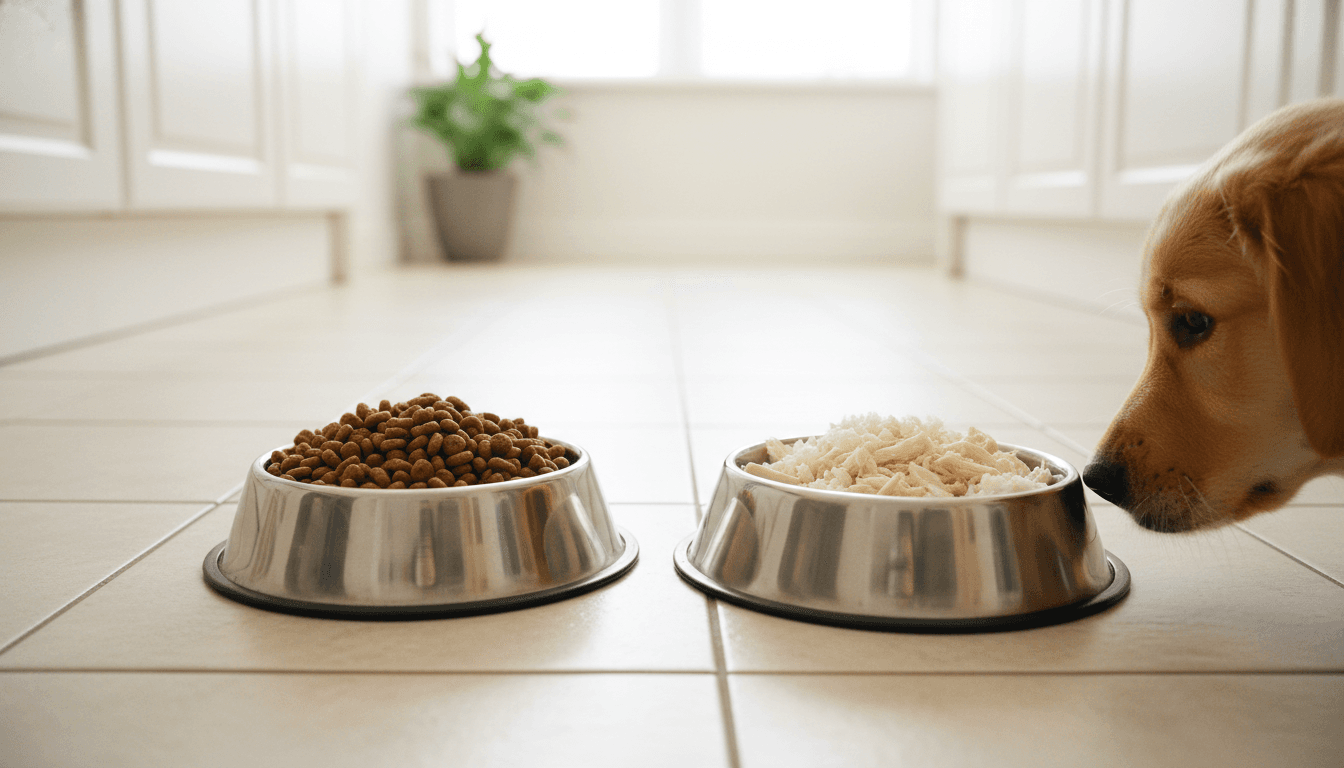
Orijen's formula contains 85% animal ingredients, with two-thirds fresh or raw and one-third dried, designed to mirror what Champion Petfoods calls a biologically appropriate canine diet. The Orijen Original formula lists fresh deboned chicken, fresh turkey, whole eggs, fresh Atlantic herring, and chicken liver as its first five ingredients, all weighed before cooking. Dog Food Advisor rates it an exceptional 4.5 out of 5 stars.
Royal Canin operates from a completely different premise. Its precision nutrition philosophy draws on 50-plus years of collaboration with vets and nutritionists across 32 global research centers. The Royal Canin Medium Adult India formula leads with dehydrated poultry protein, rice, and maize: a rendered-and-grain approach that Indian vets consistently recommend for digestive consistency and predictable stool quality. Dog Food Advisor rates it 2.5 out of 5 stars, a full 2-star gap driven primarily by meat-to-plant ratio scores.
The protein and fat numbers tell the core story. Orijen delivers a minimum 38% crude protein and 18% crude fat. Royal Canin Medium Adult provides 25% protein and 13% fat. Yet Orijen is AAFCO-certified for All Life Stages, including large breed gestation and lactation, meaning one formula covers puppies, adults, seniors, and breeding dogs. Royal Canin's India lineup sells 30-plus distinct life-stage and breed-specific products, adding complexity but enabling precise targeting at each life stage.
Orijen's WholePrey ratio includes muscle meat, organ meats, and cartilage in proportions that mirror a whole prey animal: approximately 65-70% muscle meat, 15% secreting organs, and 10-15% cartilage and bone. Royal Canin doesn't publish ingredient ratios but tracks digestibility coefficients across its research network, with typical digestibility for its India adult formulas reported at 82-85%.
For more on royal canin drools — food, see our royal canin drools — food guide.
For more on food labrador retriever — families, see our food labrador retriever — families guide.
Royal Canin vs Orijen: Key Specs for Indian Dog Owners (2024-2025)
| Feature | Royal Canin Medium Adult | Orijen Original |
|---|---|---|
| Crude Protein (min) | 25% | 38% |
| Crude Fat (min) | 13% | 18% |
| Animal Ingredients | Not published | 85% (2/3 fresh or raw) |
| First 3 Ingredients | Dehydrated poultry, rice, maize | Fresh chicken, turkey, whole eggs |
| Manufactured in | Pune, Maharashtra | Alberta, Canada |
| India Price (per kg) | Rs 700-830 | Rs 1,600-1,900 |
| Monthly Cost: 30kg dog | Rs 4,140-5,000 | Rs 8,100-9,200 |
| Dog Food Advisor Rating | 2.5 / 5 stars | 4.5 / 5 stars (Exceptional) |
| Breed-Specific Formulas | 30+ including Indie+ | None |
| Preservatives | Includes synthetic options | Mixed tocopherols only |
| Post-Opening Shelf Life (India) | 30-45 days | 4-6 weeks (shorter in monsoon) |
| Vet Clinic Distribution | 8,000+ India clinics | None |
| Import Duty | Zero (India-manufactured) | 54-58% effective duty |
| AAFCO Certification | Life-stage specific | All Life Stages |
India Import Tariff Math: The Real Reason Orijen Costs 3x Royal Canin Per Kilogram
The price difference between Orijen and Royal Canin in India has almost nothing to do with manufacturing costs alone. Dog food imports into India under HS Code 2309.10.00 attract 30% Basic Customs Duty, a 10% Social Welfare Surcharge on that BCD, and 18% Integrated GST applied on the CIF-plus-BCD value. According to the CBIC India GST rate schedule, the total effective import burden on Orijen reaching India runs approximately 54-58% of CIF value, among the highest effective pet food import tariffs in any major consumer market.
Royal Canin manufactures in Pune, Maharashtra, eliminating import duties entirely on its core product lines. Royal Canin Medium Adult 3kg retails for Rs 2,100-2,500 (Rs 700-830 per kg). Orijen Original 2kg retails for Rs 3,200-3,800 (Rs 1,600-1,900 per kg). The structural cost gap is entirely regulatory, not a reflection of ingredient quality differences alone.
Monthly feeding costs illustrate the real scale. A 30kg active dog eating Orijen Original at the recommended 180-200g per day costs approximately Rs 8,100-9,200 per month. The equivalent Royal Canin Medium Adult at 250-270g per day costs Rs 4,140-5,000 per month. That Rs 4,000-5,000 monthly differential adds up to Rs 50,000-60,000 per year.
If India were to align pet food import duties with EU rates of 4-8%, Orijen's 2kg India retail price would drop to approximately Rs 1,800-2,200, bringing it within 30-40% of Royal Canin rather than the current 130-160% premium. India's high import duty is the single largest structural barrier to ultra-premium imported brands achieving mainstream adoption.
For more on food buyer's, see our food buyer's guide.
Buy the 11.4kg Bag to Narrow the Price Gap
The Orijen Original 11.4kg bag retails for Rs 15,000-18,000 in India, bringing the per-kg cost down to approximately Rs 1,316-1,579 versus Rs 1,600-1,900 for the 2kg bag. If you have cool, dry storage and a large or active dog, the larger bag reduces your effective monthly premium by approximately Rs 800-1,200. Only buy it if you can realistically finish the bag within 6 weeks of opening, especially during Mumbai or Chennai monsoon months when humidity accelerates fat oxidation. For more on foods never feed dog, see our foods never feed dog guide. For more on royal canin, see our royal canin guide.
The High-Protein Controversy: Does 38% Protein Actually Benefit or Harm Indian Dogs?
The 38% protein figure that makes Orijen stand out globally also raises real questions for Indian conditions. According to DogSpot's review of high-protein dog food in India, sedentary apartment dogs, estimated at 65-70% of urban pet dogs in cities like Mumbai and Bangalore, may not require protein at that level. Excess dietary protein in healthy dogs gets converted to energy or excreted as nitrogen waste, potentially increasing kidney metabolic load over an 8-10 year lifespan.
That concern needs important context, though. Orijen's fresh protein sources (chicken, herring, turkey) have biological digestibility of 80-92%, versus approximately 65-78% for Royal Canin's rendered dehydrated poultry protein. Dogs absorb more of Orijen's protein at the cellular level and excrete proportionally less nitrogen waste than the headline percentage implies.
Working and sporting breeds are a different story entirely. German Shepherds in police and military service, Labrador Retrievers as guide dogs, and Belgian Malinois in private security are high-activity dogs that benefit significantly from Orijen's protein and caloric density. Canine training centers in Delhi, Mumbai, and Bangalore report observable improvements in stamina and coat condition after switching performance dogs to Orijen.
One additional factor worth considering: Orijen's grain-free formulation was investigated by the US FDA from 2019 to 2022 for potential links to dilated cardiomyopathy in dogs. The investigation closed in 2022 without finding a definitive causal link. Still, Indian vets remain cautious about exclusively grain-free diets for Golden Retrievers and Doberman Pinschers, both popular breeds in India. Royal Canin's grain-inclusive formulas sidestep this ongoing clinical concern.
For more on homemade commercial food, see our homemade commercial food guide.
Shelf Life in India's Monsoon: Orijen's Natural Preservation vs Royal Canin's Tropical Stability Engineering
Orijen uses only mixed tocopherols (Vitamin E) as its preservative, with no BHA, BHT, or ethoxyquin. That's genuinely appealing for health-conscious Indian owners, but natural tocopherols have a shorter active window than synthetic alternatives. Orijen recommends consuming opened bags within 6 weeks. Mumbai, Chennai, and Kolkata experience monsoon humidity of 80-95% from June to September, which accelerates fat oxidation in Orijen's high-fat (18-22%) formula.
Royal Canin's Pune manufacturing facility developed formulations with enhanced moisture stability for India's tropical climate, including modified emulsifiers and specific fat-coating processes for the kibble surface. Its unopened shelf life is 18 months, with a post-opening recommendation of 30-45 days. For multi-dog Indian households buying 10-15kg bulk bags, that practical storage window is meaningfully more manageable.
Orijen's resealable multilayer foil-lined bags with zipper closure, introduced around 2019, improved moisture protection significantly over older packaging. The bags still require storage below 25 degrees Celsius, a condition difficult to maintain in the estimated 60% of Indian urban apartments without dedicated air-conditioned storage during April-June summer months.
A practical workaround for Orijen users in India: transfer kibble immediately to an airtight food-grade container upon opening. Quality stainless steel or BPA-free plastic containers for 2-6kg of kibble cost Rs 500-2,000. This effectively adds Rs 250-500 per month to true Orijen ownership costs in India, a cost increment that doesn't apply to Royal Canin's climate-stable formula.
Breed Coverage Gap: Royal Canin's 30+ India-Tailored Formulas vs Orijen's Universal Approach
Royal Canin India's breed-specific lineup is its clearest competitive advantage. The brand offers dedicated formulas for India's 10 most popular registered breeds: Labrador Retriever, German Shepherd, Golden Retriever, Shih Tzu, Dachshund, Boxer, Rottweiler, Pomeranian, Beagle, and Great Dane. Each formula targets breed-specific physiology. The Labrador formula features a unique X-shaped kibble designed to slow rapid eating, a clinically relevant trait for India's most popular and most-surrendered breed.
Orijen offers zero breed-specific formulas. Champion Petfoods provides life-stage and protein-source variants: Original (chicken/turkey/fish), Six Fish (all-seafood), Regional Red (beef/lamb/boar), Tundra (venison/bison/elk), plus Large Breed, Senior, and Puppy lines. Selecting Orijen means choosing by protein source preference, not breed. That works well for owners who already understand canine nutritional science, but it's unfamiliar territory for most first-generation Indian dog owners accustomed to breed-specific products.
Royal Canin's Indie+ formula deserves specific mention. Developed for India's mixed-breed and desi dogs, it's the only major branded dog food designed explicitly for India's largest owned dog population, estimated at 35-40 million owned indie and mixed-breed dogs. The formula accounts for lean body structure, heat adaptation, and the hardy digestive system of Indian pariah-type dogs. Orijen has no India-specific product at all.
For toy breeds, the economics shift noticeably. Orijen's caloric density of 3,900-4,200 kcal per kg means smaller daily portions: approximately 50-70g per day for a 5kg dog versus Royal Canin Mini Adult's 80-100g. For Shih Tzus, Pomeranians, and Spitz breeds popular in Indian urban apartments, the daily cost differential narrows to 1.8-2x rather than the 2.5x seen in larger breeds.
India's Raw Feeding Movement: How Orijen Became the Gateway Food for India's BARF Community
India's raw feeding community has grown substantially in urban metros. Facebook groups focused on BARF feeding for Indian dogs collectively reach 80,000-120,000 members, with active WhatsApp networks spanning Mumbai, Delhi, Bangalore, and Chennai. Among raw feeders who supplement with dry kibble, Orijen is by far the most recommended brand. Its 85% animal ingredient composition and fresh-ingredient philosophy is viewed as the closest commercially available dry food approximation to a raw diet.
Many Indian BARF practitioners use Orijen as a travel food, boarding fallback, or monsoon-season backup when fresh raw meat sourcing becomes unreliable. A typical usage pattern: 20-30% of the dog's weekly diet from Orijen while feeding raw chicken, goat, or fish for the rest. Orijen explicitly supports this mixing approach. Royal Canin cautions against mixing its formulas with raw or home-cooked food, citing nutritional calibration designed for sole-feeding.
That philosophical difference carries real weight in India, where adding home-cooked rice, curd, or boiled chicken to commercial dog food is culturally normal among first-generation dog owners. Orijen's mixing-friendly positioning aligns with Indian household feeding patterns in a way Royal Canin's precision nutrition philosophy simply doesn't.
The omega-3 effect drives much of Orijen's word-of-mouth adoption across Indian cities. Owners switching to Orijen consistently report visible coat quality improvements within 6-8 weeks. Orijen's EPA and DHA content from fresh herring, salmon, and mackerel delivers approximately 0.8-1.2% omega-3 fatty acids, significantly higher than Royal Canin Medium Adult's approximately 0.3-0.5%. In India's heat, omega-3s are particularly valuable for combating stress-related shedding and seasonal itching common in Labradors and Golden Retrievers.
Frequently Asked Questions
What does 'biologically appropriate' mean in Orijen, and does it actually benefit Indian dogs?
Why does Orijen cost roughly 3x Royal Canin per kilogram in India?
Is Orijen's 38% protein level safe for Indian dogs, especially sedentary apartment breeds?
How should I store Orijen in India's monsoon season to prevent rancidity?