Key Takeaways
- Mumbai 2BHKs average 650-850 sq ft carpet area. That's barely enough for one large breed. Hyderabad's newer gated community 2BHKs at 1,100-1,400 sq ft are India's most dog-friendly apartment format.
- Labrador Retrievers are the most heat-adapted large breed for Indian apartments: short single coat, most-registered at KCI, and less likely to trigger RWA conflict than guard-dog breeds.
- RWAs cannot legally ban dogs by size or breed. AWBI advisories and High Court rulings in Maharashtra (2021), Karnataka (2019), and Delhi (2022) confirm this, but 41% of societies still enforce informal restrictions.
- True monthly ownership costs: Rs 4,000-7,000 for small breeds vs Rs 9,000-18,000 for large breeds. Professional dog walkers for a large breed can add another Rs 8,800-22,000 per month.
- 55% of Indian dog owners chose their breed on appearance. 34% said in retrospect they would have chosen differently, most citing space, heat, and exercise time as the real constraints.
Square Footage Reality: How Indian Apartment Sizes Map to Breed Space Needs
The number on your sale deed is almost always wrong for dog-sizing purposes. Super built-up area, the figure quoted in property listings across India, is 25-35% larger than actual carpet area. A Mumbai flat sold as 1,100 sq ft may have only 750-800 sq ft of usable floor space, and that's the number that matters when you're choosing a dog.\n\nA typical Mumbai 2BHK has a carpet area of 650-850 sq ft, roughly the footprint of a doubles badminton court. AKC guidelines recommend a minimum of 600 sq ft of dedicated indoor space per large dog over 25 kg. That means a Labrador or Golden Retriever in a compact Mumbai flat consumes virtually the entire usable floor area of the apartment.\n\nBangalore and Delhi NCR 2BHKs average 900-1,200 sq ft carpet area, giving 25-40% more room than Mumbai equivalents. According to Housing.com's 2025 apartment size report, Hyderabad's newer gated community 2BHKs average 1,100-1,400 sq ft carpet area, the most spacious apartment format in India's major metros. That extra room changes which breeds are comfortable, since a 30 kg dog needs room to turn, stretch, and play indoors when walks are cut short by monsoon or heat.\n\nSmall breeds under 10 kg - Shih Tzu, Dachshund, Toy Poodle, Maltese - need approximately 200-300 sq ft of clear floor space indoors. Even a Mumbai 1BHK of 450 sq ft carpet area provides adequate indoor space for these breeds. Daily short walks outdoors remain essential for mental stimulation, but the base indoor requirement is well within even the most compact Indian flat.\n\nFor more on collar harness dogs — comparison, see our collar harness dogs — comparison guide.\n\nLearn more in our detailed owner resource.
The Heat Equation: Which Large Breeds Actually Survive Indian Summers
Climate is the factor most absent from Indian dog-buying conversations, and it causes the most preventable suffering.\n\nChennai regularly records 38-42 degrees Celsius with 80-90% relative humidity in April through June. Double-coated northern breeds - Siberian Husky, Alaskan Malamute, Chow Chow, Saint Bernard - are physiologically unsuited to these conditions. Per Paws India's veterinary guide on heat stress in large breeds, heat stroke presents most commonly in double-coated breeds during South Indian pre-monsoon periods.\n\nLabrador Retrievers, despite weighing 25-35 kg, carry a short single-layer coat and handle Indian heat comparatively well. Their position as the most-registered breed at the Kennel Club of India, with Mumbai, Delhi, and Bangalore collectively accounting for over 60% of annual KCI registrations, reflects a practical convergence of temperament and climate tolerance.\n\nBrachycephalic breeds present a different problem. Pugs, French Bulldogs, and English Bulldogs are small enough for apartments but highly prone to breathing distress when ambient temperature exceeds 32 degrees Celsius. Indian vets report increased BOAS (Brachycephalic Obstructive Airway Syndrome) emergency visits during Mumbai and Delhi pre-monsoon windows.\n\nGerman Shepherds and Rottweilers have medium-to-long double coats. In North Indian cities where temperatures cross 45 degrees Celsius in May, keeping these breeds comfortable requires 8-12 hours of air-conditioning per day during summer. That adds an estimated Rs 1,500-2,500 to monthly electricity bills in Delhi and Lucknow.\n\nAn INDog at 15-22 kg is the only breed naturally evolved for the Indian subcontinent's climate. With slender builds, short coats, and metabolic adaptations for heat, city shelter-adopted INDogs are the climate-optimal medium-size choice for Indian apartment dwellers. Their reduced genetic disease burden compared to purebreds also meaningfully lowers lifetime veterinary costs.\n\nFor more on new owner mistakes 2026, see our new owner mistakes 2026 guide.
RWA Red Flags: What Indian Housing Societies Can and Cannot Legally Restrict
The legal position in India is clear. Housing societies cannot impose blanket bans on pets or restrict pet ownership based on breed size or weight.\n\nThe Animal Welfare Board of India (AWBI), a statutory body constituted under the Prevention of Cruelty to Animals Act 1960, has issued advisories clarifying this explicitly. Per the AWBI advisory on companion animals in residential societies, residents have the right to keep companion animals subject to reasonable conditions that don't infringe on neighbours' rights. These advisories have been cited in multiple High Court rulings across the country.\n\nIn 2021, the Bombay High Court ruled that a housing society resolution restricting residents from keeping pet dogs is illegal and unenforceable. Similar rulings exist in Karnataka (2019) and Delhi (2022). The legal consensus across India's major jurisdictions is consistent on this.\n\nWhat RWAs can legitimately require: dogs on leash in all common areas, proof of vaccination and municipal registration, prompt cleanup of pet waste, and restrictions on access to pools and children's play areas. What they can't do: ban specific breeds by size or weight, charge discriminatory pet deposits, or bar dogs from elevators. These are clear lines under current Indian case law.\n\nThe gap between legal rights and practical reality is significant. A 2023 survey of housing societies in Pune, Mumbai, and Bangalore found that 41% still enforce informal breed-size restrictions targeting dogs over 25 kg, despite these being legally unenforceable. Large breed owners in such societies frequently report escalating conflict with RWA management and security staff.\n\nCase law is sparse in Uttar Pradesh, Rajasthan, and Madhya Pradesh, where RWA bans on large breeds are more commonly enforced without challenge. Dog owners in these states are advised to document all RWA communications in writing, reference AWBI advisory circulars explicitly, and if necessary escalate to the district collector's office or local SPCA.\n\nFor more on traveling india, see our traveling india guide.
Before You Sign Any Sale or Rental Agreement
Ask the RWA management committee in writing whether they have any resolutions or bylaws about pets. Request their specific position on large breeds. Document their response. If they indicate a large-breed ban is in force, send a written response citing the AWBI advisory and the relevant state High Court ruling. Informal bans are most easily contested before you move in, not after.\n\nFor more on flying india, see our flying india guide.
The Monthly Bill: True Small vs Large Dog Costs in Indian Rupees (2026)
The purchase price of a dog is the smallest number in the ownership equation. Monthly running costs determine whether the decision is sustainable.\n\nFood is the largest recurring expense and scales directly with body weight. Monthly premium dry food for a 5 kg small breed like a Shih Tzu or Pomeranian runs Rs 1,200-2,500, consuming 1.5-2 kg of kibble per month. A 30 kg Labrador or German Shepherd eats 14-18 kg of the same brand-tier food at Rs 4,500-8,000 per month, three to four times more every single month.\n\nRoutine veterinary costs follow a similar pattern. Annual vaccines, deworming, and flea and tick prevention average Rs 8,000-12,000 for small breeds and Rs 14,000-22,000 for large breeds in metro areas, according to Euromonitor's India Pet Care 2025 report. Drug doses are weight-based, so treating a 30 kg dog for the same condition costs five to six times more than treating a 5 kg dog.\n\nGrooming costs track coat type more than size. A Labrador's short coat costs Rs 500-800 per professional session, while a Shih Tzu's long coat requires attention every four to six weeks at Rs 900-1,600. In India's humid summers, an ungroomed Shih Tzu develops painful skin matting within six to eight weeks, making professional grooming non-negotiable.\n\nBoarding costs are rarely considered during the initial buying decision. Professional kennels in Indian metros charge Rs 400-700 per night for small breeds and Rs 700-1,400 per night for large breeds. For a two-week Diwali or summer holiday, that's Rs 5,600-9,800 for small breeds versus Rs 9,800-19,600 for large breeds.\n\nFor more on follows everywhere, see our follows everywhere guide.
True Monthly Ownership Costs by Dog Size in Indian Metro Cities (2026) — Small Breed (under 10 kg), Medium Breed (10-25 kg)
| Cost Category | Small Breed (under 10 kg) | Medium Breed (10-25 kg) |
|---|---|---|
| Premium dry food (monthly) | Rs 1,200-2,500 | Rs 2,500-4,500 |
| Annual vet costs (amortized monthly) | Rs 650-1,000 | Rs 900-1,400 |
| Professional grooming (monthly avg) | Rs 500-1,600 | Rs 600-1,200 |
| Dog walker (2 walks/day, 22 working days) | Not typically required | Rs 4,400-11,000 |
| Boarding (2-week holiday, amortized monthly) | Rs 450-820 | Rs 620-1,050 |
| All-in estimated monthly total | Rs 4,000-7,000 | Rs 6,000-10,000 |
True Monthly Ownership Costs by Dog Size in Indian Metro Cities (2026) — Large Breed (over 25 kg)
| Cost Category | Large Breed (over 25 kg) | |
|---|---|---|
| Premium dry food (monthly) | Rs 4,500-8,000 | |
| Annual vet costs (amortized monthly) | Rs 1,150-1,850 | |
| Professional grooming (monthly avg) | Rs 500-900 | |
| Dog walker (2 walks/day, 22 working days) | Rs 8,800-22,000 | |
| Boarding (2-week holiday, amortized monthly) | Rs 820-1,630 | |
| All-in estimated monthly total | Rs 9,000-18,000 |
The 6am Walk Problem: Exercise Reality for Working Professionals in Indian Cities
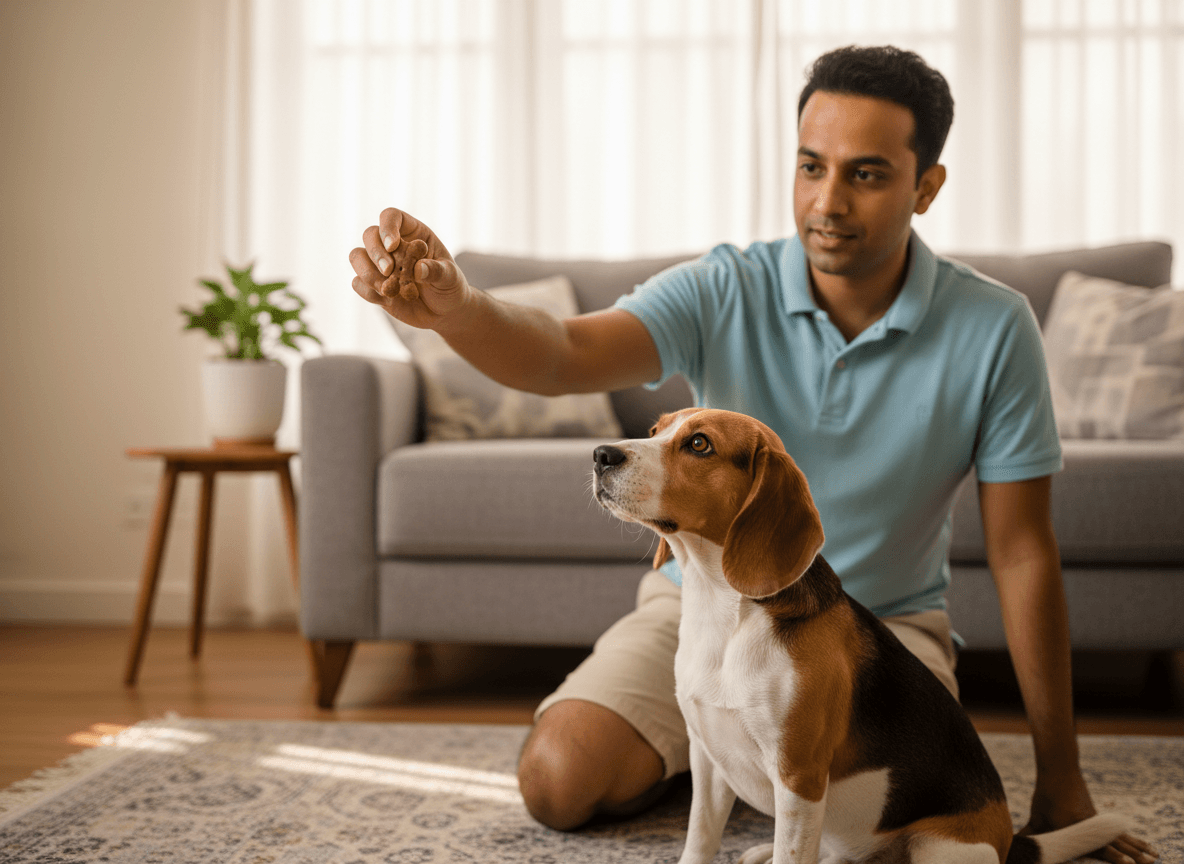
A 2024 Ipsos India survey found 68% of urban pet owners work outside the home nine to ten hours per day. Large breeds requiring 60-90 minutes of daily exercise present a logistics challenge that small breeds, needing just 20-30 minutes, simply don't. The most documented outcome in time-constrained Indian households is an under-exercised large dog presenting with destructive behaviour, excessive barking, and anxiety.\n\nOutdoor walks in Mumbai and Chennai are impractical for three to five months per year. Pre-monsoon heat from April to June brings 38-42 degree temperatures, and active monsoon flooding from June to September makes most park-level walking routes inaccessible. Large breeds unable to complete outdoor exercise during these windows need indoor activity substitutes that most Indian apartment layouts don't accommodate.\n\nProfessional dog walker services in Indian tier-1 cities, including DogSpot, Supertails, and Pawspace, charge Rs 200-500 per walk. A large breed needing two walks daily on 22 working days per month generates a dog-walker bill of Rs 8,800-22,000. This recurring cost is rarely factored into initial ownership decisions by first-time buyers.\n\nBreed fitness for apartment life can't be assessed by size alone. Beagles weigh only 10-12 kg and are commonly marketed as apartment-friendly in India, but they require over 60 minutes of daily exercise and are highly prone to howling when under-stimulated. Indian veterinary behaviourists consistently list Beagles among the top five breeds presenting for apartment-related behaviour problems in Mumbai and Pune.\n\nCavalier King Charles Spaniels (6-8 kg) and Cocker Spaniels (10-14 kg) occupy a practical middle ground. Just 30-40 minutes of daily activity satisfies both breeds, their temperament is calm indoors, and their coats tolerate air-conditioned environments well. That last point matters in Indian metro apartments where AC runs six to ten hours daily for much of the year.\n\nFor more on neuter india? benefits costs, see our neuter india? benefits costs guide.
The Verdict: A Size-to-Apartment Decision Grid for Indian Buyers
The right dog for your apartment is determined by carpet area, city climate, and your actual daily schedule, not by what looks appealing in a breeder's photos.\n\nA 2023 Supertails consumer survey found 55% of Indian dog owners selected their breed primarily on appearance. Among that group, 34% said in retrospect they would choose differently. The most common regret: a large, high-energy breed purchased for a 2BHK flat based on visual appeal, followed by years of difficulty managing space, heat, and exercise time.\n\nIn a 1BHK in Mumbai, Pune, or Chennai (400-650 sq ft carpet area), only dogs under 10 kg with low-to-moderate exercise needs are suitable. Best matches include Chihuahua, Toy Poodle, Maltese, Shih Tzu, and Pomeranian. Any breed over 15 kg should be avoided in these spaces regardless of owner commitment.\n\nResidents of 2BHK apartments with gated community green space in Bangalore or Hyderabad (900-1,200 sq ft carpet area) have more flexibility. Medium breeds weighing 10-25 kg, such as the Indian Pariah Dog, Miniature Poodle, Cocker Spaniel, and Dachshund, work well with a committed 45-minute daily walk. A Labrador or Golden Retriever is manageable here if two dedicated daily walks are genuinely guaranteed, not aspirational.\n\nThree-bedroom or larger apartments (1,400+ sq ft) with a dedicated pet-walking park on the society campus support large breeds with appropriate exercise commitment. German Shepherds, Labradors, and Golden Retrievers can all thrive in this configuration. Breeds that remain unsuitable even in large Indian apartments due to extreme heat sensitivity or exercise requirements exceeding two hours daily: Siberian Husky, Alaskan Malamute, Border Collie, Dalmatian.\n\nFor apartment dwellers who want a large dog but live in a compact flat, the Labrador Retriever is the most pragmatic choice in India. It's heat-tolerant, temperamentally adaptable, readily available from ethical breeders across all metros, and less likely to trigger informal RWA opposition than breeds with a guard-dog reputation like Rottweiler, Doberman, or German Shepherd. That practical reality in Indian society living matters even where such bans are technically unenforceable under the Prevention of Cruelty to Animals Act 1960.\n\nYou'll find good options at Dr. Palampalle's Pet Care Clinic in Pratikhsha Nagar, Sion East, Sion, Mumbai — rated 5.0/5 by pet owners. You'll find good options at Delhi dog kennel | puppies for sale in delhi | dog sale in delhi | pet shop near me | poodle puppy | shihzu in Rashid Market, Geeta Colony, Delhi — rated 5.0/5 by pet owners.
You'll find good options like Dr. Palampalle's Pet Care Clinic in Pratikhsha Nagar, Sion East, Sion — rated 5.0/5. Check our pet stores in Mumbai directory for more choices near you.
You'll find good options like Delhi dog kennel | puppies for sale in delhi | dog sale in delhi | pet shop near me | poodle puppy | shihzu in Rashid Market, Geeta Colony — rated 5.0/5. Check our pet stores in Delhi directory for more choices near you.