Key Takeaways
- Each coat type (smooth, double, wire, curly, long-silky) needs different brushing tools, bathing frequency, and seasonal routines
- Monsoon months (June-September) demand anti-fungal grooming protocols \u2014 fungal dermatitis spikes 3x during this period across India
- Indian Pariah Dogs and Indian Spitz have low-maintenance coats but still need weekly brushing and post-monsoon skin checks
- De-shedding tools like the FURminator (\u20b91,800-\u20b92,500) reduce loose hair by up to 90% during peak shedding in March-May
- Double-coated breeds (Huskies, Golden Retrievers) should never be shaved in summer \u2014 their undercoat insulates against heat
- Budget \u20b9300-\u20b9800/month on grooming supplies for short-coat breeds and \u20b9800-\u20b92,000/month for long-coat breeds
Five Coat Types and How to Identify Yours
Dogs in India fall into five coat categories, and each one responds differently to humidity, heat, and dust. Knowing your dog's coat type determines which brush you buy, how often you bathe, and what seasonal grooming adjustments to make.
Smooth-coated breeds (Indian Pariah, Dachshund, Beagle, Boxer) have short, flat-lying hair that sheds moderately. Double-coated breeds (Golden Retriever, Labrador, Husky, German Shepherd, Indian Spitz) carry a dense undercoat beneath longer guard hairs. Wire-coated breeds (Schnauzer, Wire Fox Terrier) have bristly, rough-textured fur that needs hand-stripping. Curly-coated breeds (Poodle, Bichon Frise, Cockapoo) produce continuously growing hair that mats easily. Long-silky breeds (Shih Tzu, Yorkshire Terrier, Lhasa Apso, Afghan Hound) have flowing coats that tangle in India's dusty conditions.
Run your hand along your dog's back. If you feel a soft, plush layer beneath the outer coat, you have a double-coated breed. If the hair feels wiry and stands away from the body, it is a wire coat. Most mixed-breed Indian dogs inherit the smooth coat of the Pariah lineage, making them among the easiest to maintain. Learn more in our detailed grooming resource.
Grooming Tools by Coat Type with INR Prices
Using the wrong brush damages hair follicles and irritates skin. Here is what each coat type actually needs, with prices from Indian pet retailers like Heads Up For Tails, Supertails, and Amazon India. For more on this topic, see our guide on grooming.
| Coat Type | Primary Brush | Secondary Tool | Estimated Cost (INR) |
|---|---|---|---|
| Smooth (Pariah, Beagle, Boxer) | Rubber curry brush | Bristle brush for finishing | \u20b9250-\u20b9500 |
| Double (Golden Retriever, Spitz, GSD) | Undercoat rake + slicker brush | FURminator de-shedding tool | \u20b9800-\u20b92,500 |
| Wire (Schnauzer, Fox Terrier) | Stripping knife | Slicker brush for legs/face | \u20b9600-\u20b91,200 |
| Curly (Poodle, Bichon) | Metal greyhound comb | Slicker brush + detangling spray | \u20b9400-\u20b9900 |
| Long-Silky (Shih Tzu, Lhasa Apso) | Pin brush + wide-tooth comb | Leave-in conditioner spray | \u20b9500-\u20b91,500 |
Money Saver
Buy a Wahl or Andis grooming kit (\u20b93,500-\u20b95,500 on Amazon India) if you have a curly or long-silky breed. Professional grooming sessions cost \u20b9800-\u20b92,000 per visit \u2014 the kit pays for itself within 3 visits.
Indian Pariah and Indian Spitz: Low-Maintenance Coat Care
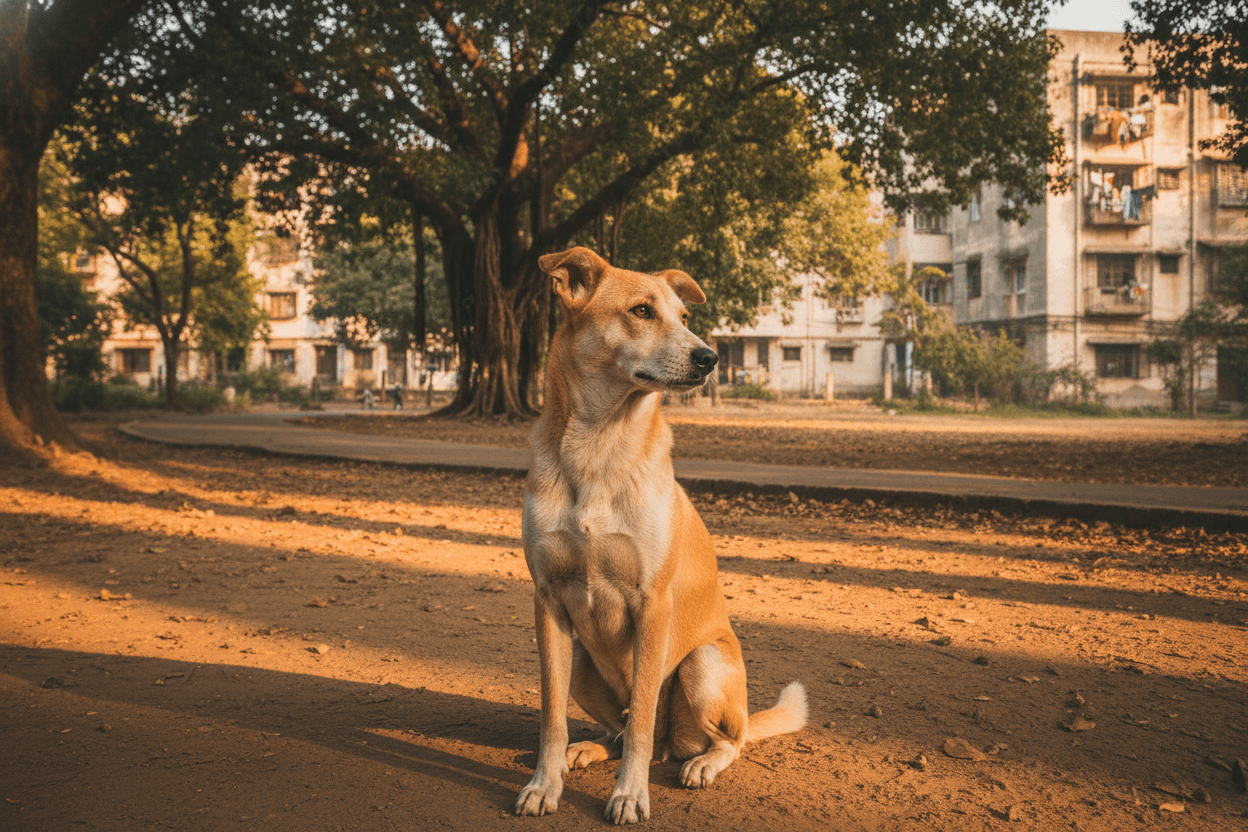
The Indian Pariah Dog has a short, dense coat evolved over thousands of years for the subcontinent's climate. It sheds lightly year-round with a heavier shed in March-April as temperatures rise. Weekly brushing with a rubber curry brush (\u20b9250-\u20b9400) removes dead hair and distributes natural oils. Bathing every 4-6 weeks with a gentle shampoo is sufficient \u2014 overbathing strips the natural oils that protect Pariah skin from dust and UV exposure.
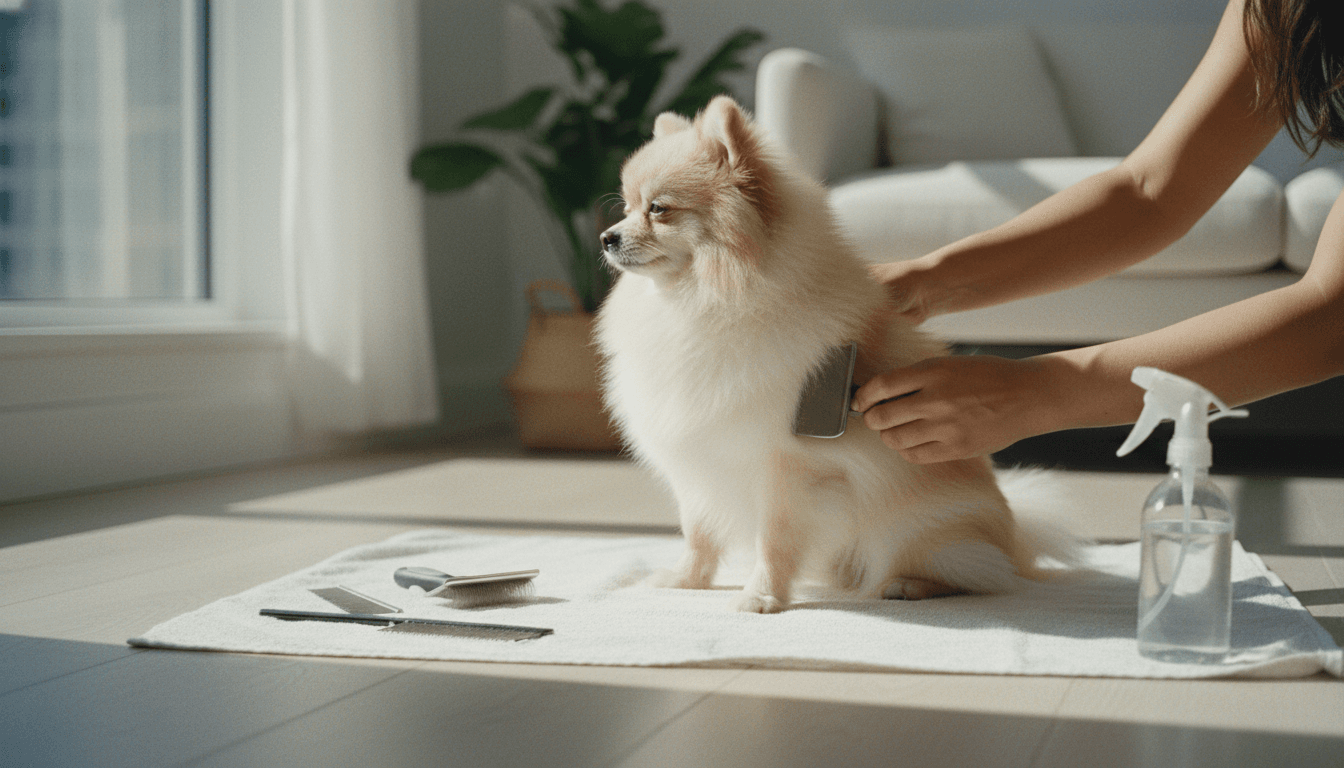
The Indian Spitz carries a double coat with a fluffy undercoat that needs more attention. During shedding season (March-May and October-November), brush 3-4 times per week with an undercoat rake to prevent matting in the dense undercoat. The Spitz coat naturally repels some dirt, so bathing every 3-4 weeks works well. Use a conditioner formulated for double coats \u2014 Captain Zack's Detangler (\u20b9450) or Bark Out Loud Conditioning Mist (\u20b9350) both work for Indian Spitz coats.
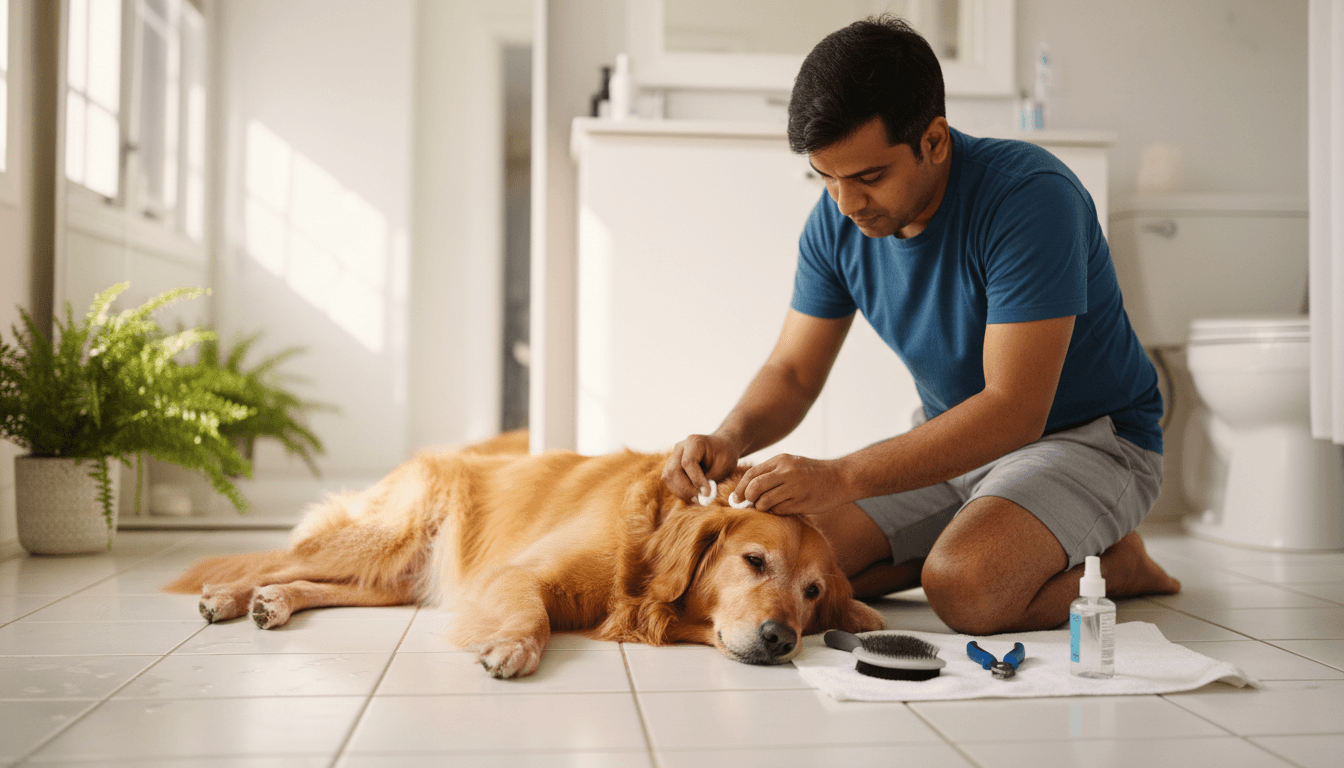
Both breeds adapt well to Indian humidity, but their ears need weekly checks during monsoon. Fold-over ears on Pariah mixes trap moisture that breeds yeast infections. Wipe inner ear flaps with a cotton ball dampened with a veterinary ear cleaner (Epi-Otic at \u20b9550-\u20b9700).
Double-Coated Breeds in Hot Indian Climate
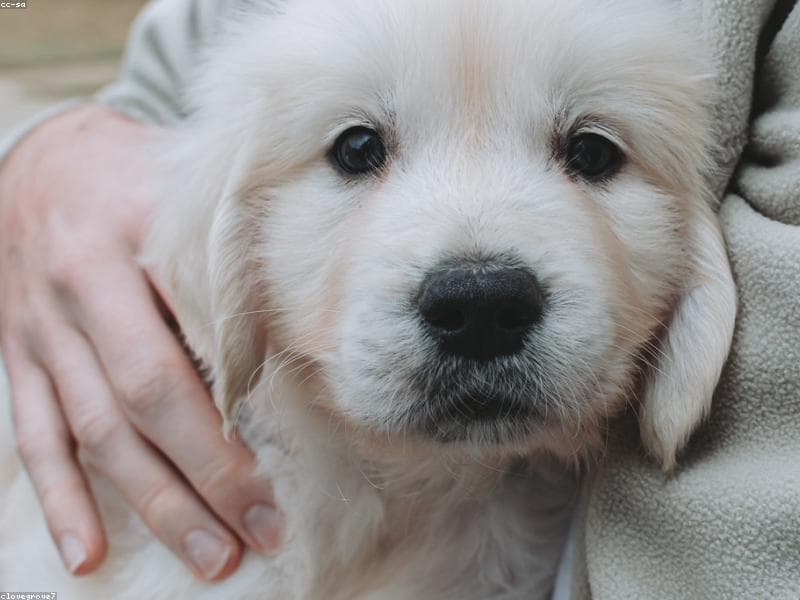
Golden Retrievers, Labrador Retrievers, Huskies, and German Shepherds are among the most popular foreign breeds in Indian cities, and all carry double coats designed for colder climates. The biggest mistake owners make is shaving these dogs in summer. The undercoat actually insulates against heat \u2014 shaving removes this protection and can cause sunburn, patchy regrowth, and a condition called post-clipping alopecia.
Instead of shaving, use an undercoat rake (\u20b9400-\u20b9700) or FURminator de-shedding tool (\u20b91,800-\u20b92,500) to thin the undercoat. Brush every 2-3 days during peak shedding (March-May). A single 20-minute session with a de-shedding tool removes enough loose undercoat to noticeably reduce your dog's heat discomfort. Follow with a slicker brush to catch remaining loose hair.
Bathe double-coated dogs every 3-4 weeks using a shampoo that reaches through the guard hair to clean the undercoat. Tropiclean Oatmeal & Tea Tree (\u20b9650) or Wahl Dirty Beastie (\u20b9750) work well. Always blow-dry completely after bathing \u2014 a damp undercoat in Indian humidity breeds fungal infections within 48 hours. If you lack a pet dryer (\u20b92,500-\u20b94,500), a regular hair dryer on the cool setting works, though it takes 30-45 minutes for a Golden Retriever. Our nail trimming: safe techniques guide covers this in detail.
DodoDoggy Tip
Never use a furminator on a wet coat or press too hard \u2014 it can cut through guard hairs. Brush in the direction of hair growth and stop when you no longer see loose undercoat coming out.
Monsoon Coat Care: Preventing Fungal and Bacterial Skin Issues
June through September is the hardest season for dog coats in India. Humidity above 80% combined with temperatures of 28-35\u00b0C creates ideal conditions for fungal dermatitis, hot spots, and bacterial folliculitis. Veterinary clinics across Mumbai, Kolkata, Chennai, and Bangalore report a 3x increase in skin infection cases during monsoon months.
After every walk in rain or through wet grass, towel-dry your dog thoroughly \u2014 especially between the toes, inside ear flaps, and in skin folds. For double-coated breeds, use an absorbent microfiber towel (\u20b9200-\u20b9400) followed by a blow dryer. Leaving moisture trapped in the undercoat for more than a few hours almost guarantees fungal growth.
- Apply an anti-fungal spray (Ketochlor spray at \u20b9350 or Sebozole spray at \u20b9300) after rainy walks, focusing on paws and underbelly
- Switch to a medicated shampoo containing ketoconazole or chlorhexidine for monsoon months \u2014 Aloveen Oatmeal (\u20b9480) or Ketochlor Shampoo (\u20b9400-\u20b9550)
- Increase brushing frequency to daily during monsoon \u2014 this removes damp dead hair that traps moisture against the skin
- Check for early signs of fungal infection: circular bald patches, red or flaky skin, musty odor, excessive scratching at a specific spot
- Keep your dog's sleeping area dry with elevated beds (\u20b9800-\u20b92,500) rather than floor mats that absorb ground moisture
- Add 1 teaspoon of virgin coconut oil (\u20b9150-\u20b9300 for 500ml) to meals 3x per week \u2014 lauric acid supports skin barrier function
DodoDoggy Tip
If your dog develops a circular bald patch or persistent scratching during monsoon, see a vet within 48 hours. Fungal ringworm spreads rapidly in humid conditions and is zoonotic \u2014 it transfers to humans. Early treatment with oral antifungals (\u20b9300-\u20b9600 for a course) resolves it in 2-3 weeks versus 6-8 weeks if delayed.
Summer De-Shedding: Products and Schedule
March through May is peak shedding season for most breeds in India. As temperatures climb past 35\u00b0C, dogs shed their winter undercoat in heavy clumps. Without regular de-shedding, this loose hair mats against the skin, blocks airflow, and traps heat \u2014 exactly what you are trying to prevent.
| Product | Best For | Price (INR) | Where to Buy |
|---|---|---|---|
| FURminator de-shedding tool (Medium) | Double-coated breeds (GSD, Goldens, Spitz) | \u20b91,800-\u20b92,500 | Amazon India, Heads Up For Tails |
| Safari de-matting comb | Long-silky breeds with tangles | \u20b9450-\u20b9700 | Amazon India, Supertails |
| Hertzko self-cleaning slicker brush | All coat types, daily maintenance | \u20b9600-\u20b9900 | Amazon India |
| Wahl de-shedding shampoo | Bath-time loose hair removal | \u20b9550-\u20b9750 | Amazon India, pet stores |
| Petvit de-shedding spray (Indian brand) | Between-bath coat conditioning | \u20b9280-\u20b9380 | Supertails, Zigly |
Follow this schedule during peak shedding months: brush with a slicker brush every other day (10-15 minutes), use the de-shedding tool twice per week (15-20 minutes per session), and bathe with a de-shedding shampoo every 2-3 weeks. For Indian Pariah Dogs that shed less, a weekly rubber curry brush session and monthly bath is enough.
Breed-Specific Grooming for Popular Indian Breeds
Beyond coat type, individual breeds have quirks that affect grooming. Here is a quick reference for the breeds most commonly seen at Indian veterinary clinics and grooming salons.
| Breed | Coat Type | Brushing Frequency | Bathing Frequency | Key Concern in Indian Climate |
|---|---|---|---|---|
| Indian Pariah | Smooth | Weekly | Every 4-6 weeks | Tick infestations in grassland areas |
| Indian Spitz | Double | 2-3x/week, daily in shedding season | Every 3-4 weeks | Matting in undercoat during monsoon |
| Labrador Retriever | Double (short) | 2-3x/week | Every 3-4 weeks | Ear infections from swimming/rain |
| Golden Retriever | Double (long) | Daily | Every 3-4 weeks | Hot spots from trapped moisture |
| German Shepherd | Double | Daily during shed, 3x/week otherwise | Every 4-6 weeks | Heavy shedding Mar-May and Sep-Nov |
| Pug | Smooth (dense) | 2x/week | Every 3-4 weeks | Facial fold dermatitis in humidity |
| Shih Tzu | Long-silky | Daily | Every 2-3 weeks | Eye staining and matting |
| Poodle | Curly | Daily | Every 2-3 weeks | Matting if not clipped every 6-8 weeks |
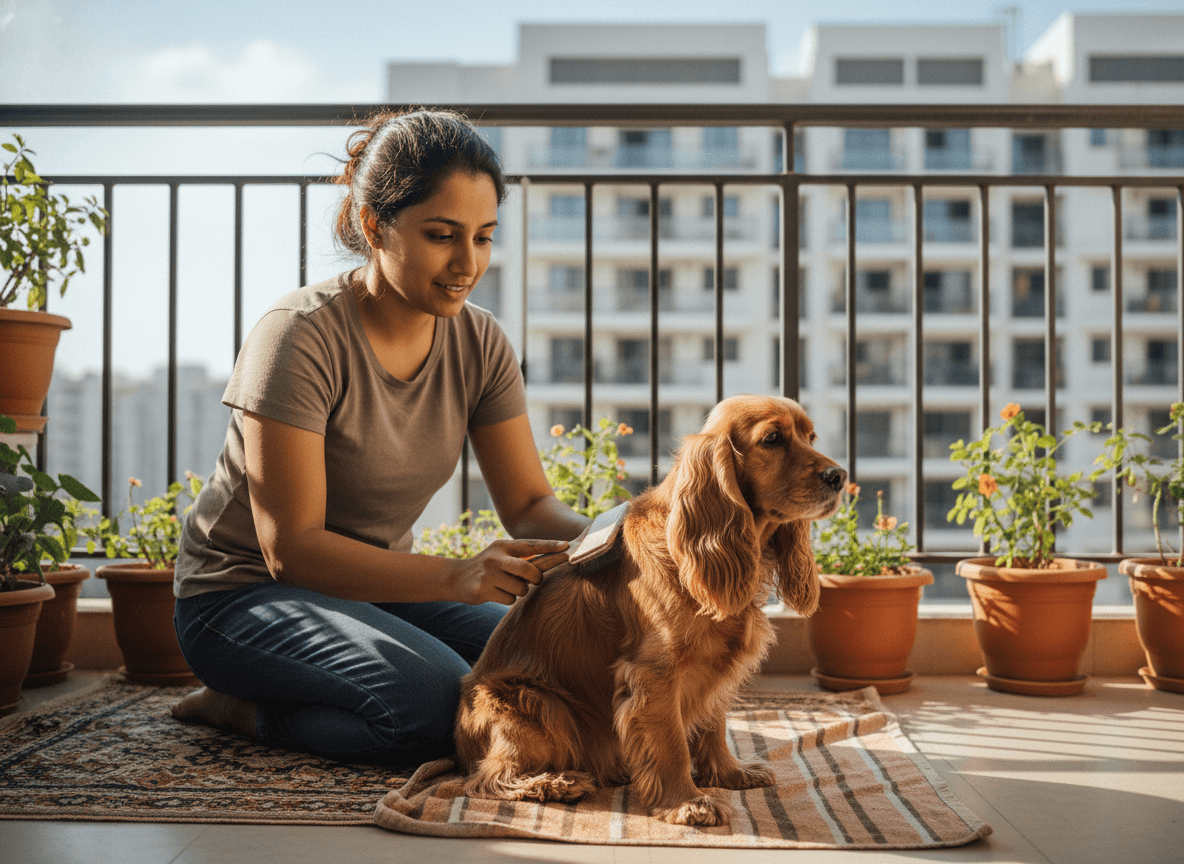
| Cocker Spaniel | Long-silky (wavy) | Daily | Every 2-3 weeks | Ear infections from floppy, hairy ears |
| Rottweiler | Smooth (dense) | 2x/week | Every 4-6 weeks | Heat stress \u2014 focus on cooling, not grooming |
Grooming Costs: DIY vs Professional in Indian Cities
Professional grooming prices vary significantly between metro cities and smaller towns. Here is what to expect for a full grooming session (bath, brush, nail trim, ear cleaning, and basic styling) at salons in major Indian cities.
| City | Small Breed (Pug, Shih Tzu) | Medium Breed (Beagle, Spitz) | Large Breed (GSD, Golden Retriever) |
|---|---|---|---|
| Mumbai | \u20b91,200-\u20b92,000 | \u20b91,500-\u20b92,500 | \u20b92,000-\u20b93,500 |
| Delhi NCR | \u20b91,000-\u20b91,800 | \u20b91,200-\u20b92,200 | \u20b91,800-\u20b93,000 |
| Bangalore | \u20b91,000-\u20b91,800 | \u20b91,200-\u20b92,000 | \u20b91,800-\u20b93,000 |
| Hyderabad | \u20b9800-\u20b91,500 | \u20b91,000-\u20b91,800 | \u20b91,500-\u20b92,500 |
| Tier-2 cities (Pune, Jaipur, Kochi) | \u20b9600-\u20b91,200 | \u20b9800-\u20b91,500 | \u20b91,200-\u20b92,000 |
DIY grooming with quality tools costs \u20b93,000-\u20b96,000 upfront for brushes, shampoo, nail clippers, and ear cleaner. If your breed needs professional grooming monthly (Poodles, Shih Tzus, Cocker Spaniels), DIY basic maintenance between salon visits halves your annual grooming bill. For smooth-coated breeds like Pariahs and Beagles, DIY is completely practical \u2014 you rarely need a salon at all.
Money Saver
Many salons in Delhi, Mumbai, and Bangalore offer grooming packages \u2014 6 sessions prepaid at 15-25% discount. Heads Up For Tails, PetStar, and Just Dogs are chains that offer this across multiple cities.
Common Coat Problems in Indian Dogs and How to Fix Them
Indian climate creates specific coat problems that differ from what Western grooming guides cover. Dust, pollution in metros, hard water, and seasonal extremes all affect coat health.
- Dull, dry coat: Usually caused by hard water (common in Delhi, Rajasthan, parts of Karnataka). Install a shower filter (\u20b91,200-\u20b92,500) or do a final rinse with filtered water. Add omega-3 fish oil to meals (Drools Absolute Salmon Oil, \u20b9350 for 300ml)
- Excessive shedding outside season: Could signal thyroid issues (common in Golden Retrievers and Labradors), poor diet, or stress. If shedding is accompanied by bald patches, see a vet for a T4 thyroid test (\u20b9800-\u20b91,200)
- Matting in double coats: Happens fast during monsoon. Work through mats with a dematting comb from the ends upward \u2014 never pull from the root. For severe mats, cut them out rather than tearing through them
- Tick and flea damage: Ticks burrow into the coat and cause bald patches and skin irritation. Use monthly spot-on treatments (Fiprofort Plus at \u20b9180-\u20b9250 per dose) and check your dog's coat after every outdoor session
- Fungal smell and flaky skin: Common in monsoon. Switch to a chlorhexidine shampoo (\u20b9400-\u20b9550) and ensure complete drying after every bath. If it persists beyond 5 days, get a skin scraping test at the vet (\u20b9300-\u20b9500)
Conclusion
Coat care depends entirely on coat type and the season you are in. A Poodle in Bangalore monsoon needs a completely different routine than an Indian Pariah in Delhi winter. Identify your dog's coat type using the guide above, match the right tools, and adjust your schedule for monsoon and summer shedding. The time you invest in proper coat maintenance directly reduces veterinary skin treatment costs \u2014 which average \u20b92,000-\u20b95,000 per fungal or bacterial infection episode. For a broader overview, see our complete dog grooming guide.
If you're in Bengaluru, costs vary significantly by neighbourhood — Raghavendra Colony, Chamrajpet averages ₹300 while DOMALUR, Domlur runs around ₹8,500.