My Golden Retriever, Mango, had her first fungal hot spot in our second Mumbai monsoon. I'd been drying her coat after walks \u2014 or so I thought. Turns out, I was missing the belly completely, and the dense fur there stayed damp for hours. One vet visit at Cessna Lifeline and \u20b92,400 in medicated shampoo and antifungal tablets later, I understood something no generic grooming guide had told me: India's climate doesn't just make grooming more frequent, it changes the entire logic of what you're doing and why.
This guide is built around that logic. Not a checklist of steps that work equally well in London or Chennai, but the actual decisions that matter when you're dealing with 90% humidity in Kolkata, 45\u00b0C pavement in Delhi, or the six-month coastal dampness of Kochi. Every recommendation here maps to a specific Indian condition.

Why Indian Climate Changes Grooming Fundamentals
India has four distinct grooming seasons, and each one creates a different risk profile for your dog's skin and coat. Summer (March\u2013June) brings heat stress and paw burns on urban concrete. Monsoon (June\u2013September) creates persistent dampness that feeds fungal and bacterial infections. Post-monsoon (October\u2013November) is tick peak season. Winter in north India (December\u2013February) dries out skin and paw pads.
In the UK or US, a dog can air-dry after a walk without consequence. In Chennai or Hyderabad between June and August, the same habit causes recurring malassezia (yeast) infections within weeks. According to Vetic's pet health blog, fungal skin infections spike during India's monsoon months because humidity above 80% creates conditions where Malassezia pachydermatis \u2014 a yeast naturally present on dog skin \u2014 overgrows rapidly. The result is a smelly, itchy, inflamed coat that needs antifungal treatment.
That's the core insight. Grooming in India isn't cosmetic maintenance \u2014 it's active infection prevention.
Warning
India-specific risk: Malassezia yeast infections spike in monsoon cities. Any dog left partially damp for more than 2 hours is at risk, especially in skin folds, between toes, and under the belly.
Summer Grooming: March Through June
The biggest summer mistake I see in Delhi and Bangalore apartment buildings is owners shaving their double-coated dogs. It seems logical \u2014 remove the fur to beat the heat. But for breeds like Golden Retrievers, Huskies, German Shepherds, and Labradors, that coat is an insulating layer that blocks direct solar radiation. Shave it off and you've removed the sunscreen. According to vets at Vetic, completely shaving a double-coated breed in summer actually increases heat absorption and can trigger heat exhaustion in dogs that were managing fine before.
What works instead: trim to 2.5\u20133 cm (not flush to skin), de-shed the undercoat aggressively with an undercoat rake, and focus cooling elsewhere. Keep the outer coat intact.
Bathing Frequency by Coat Type \u2014 Summer
| Coat Type | Summer Bathing Schedule |
|---|---|
| Short-coated (Indie, Beagle, Dachshund) | Every 10\u201314 days |
| Medium-coated (Labrador, Boxer) | Every 7\u201310 days |
| Long/double-coated (Golden Retriever, GSD) | Every 7 days with anti-shed pre-bath brush |
| Heavily wrinkled (Pug, Bulldog) | Every 5\u20137 days; clean folds daily |
Shampoo choice matters here. For summer, a mild oatmeal shampoo like Virbac Episoothe (\u20b9335 for 200 ml at Heads Up For Tails) works well for sensitive skin and doesn't strip natural oils. For dogs already showing skin irritation, Virbac Ketochlor (\u20b9356, 200 ml) handles both fungal and bacterial concerns.
Paw Care on Indian Pavements
Delhi and Mumbai concrete reaches 60\u201370\u00b0C by noon in June. A simple test: press your palm flat on the pavement. If you can't hold it there for 5 full seconds, it's too hot for paws. According to Petkonnect's paw care guide, Indian urban surfaces in summer cause pad burns faster than dog owners expect \u2014 because dogs don't flinch from the first-second contact, owners miss the cumulative damage.
Walk before 7:30 AM or after 7 PM. Apply paw balm \u2014 Pet Head Oatmeal Paw Butter or Petbarn Paw Butter \u2014 before outdoor walks on hot days. Trim the hair between paw pads every two weeks; it collects heat and debris. After each walk, rinse paws in lukewarm water with a very small amount of diluted Betadine, dry completely, and check between the toes.
Monsoon Grooming: June Through September
Monsoon grooming is a discipline of drying, not washing. You don't need to bathe your dog every time they get wet \u2014 that would strip natural oils and make the skin more vulnerable. What you must do is dry them thoroughly every single time.
Here's the post-walk routine that works in Mumbai and other high-humidity cities. Get an absorbent microfiber towel (\u20b9400\u2013\u20b9600 on Amazon.in). The moment you're back inside: towel-dry paws and between the toes first, then belly, then armpits, then ears. For long-coated dogs, follow with a pet blow-dryer on the lowest heat setting (Andis Pro Animal, around \u20b93,200, or any low-noise pet dryer). The coat should feel dry to the touch before you let the dog settle on their bed.
Anti-Fungal Shampoo Rotation
During monsoon, swap your regular shampoo for an antifungal formula every other bath. The Pet Natural Remedy blog recommends neem-based shampoos for their natural antifungal properties. Himalaya Erina-EP tick and flea shampoo (\u20b9170 for 200 ml) doubles as an antiparasitic and has a mild antifungal effect. For dogs with existing skin sensitivity, stick to Virbac Episoothe and apply antifungal powder (Candid Dusting Powder, off-label vet-advised use) only in skin folds.
One thing that surprised me: the smell. Wet dog smell in monsoon is often early-stage yeast, not just damp fur. If your dog smells musty within a few hours of drying, it's time for a vet check and likely a course of Virbac Ketochlor or a Malaseb shampoo protocol. At Vetic clinics, an antifungal consultation runs about \u20b9500\u2013\u20b9700, and a two-week medicated shampoo protocol including the product costs roughly \u20b9900\u2013\u20b91,400 total.
Ear Care in Humid Conditions
Floppy-eared breeds \u2014 Cocker Spaniels, Beagles, Basset Hounds \u2014 are at highest risk for otitis externa (outer ear infection) in India's monsoon. The ear flap blocks airflow, the ear canal stays humid, and bacteria multiply rapidly. Clean ears every 5\u20137 days during monsoon using a vet-approved ear cleaner like Cliny (\u20b9450, available at Supertails and Heads Up For Tails). Squirt in, massage the base for 30 seconds, let the dog shake, then wipe with cotton.
Signs that it's gone past prevention: head shaking, pawing at the ear, dark brown or black discharge, or a yeasty smell from the ear canal. That needs a vet visit, not more home cleaning.
Tick and Flea Management
Monsoon is peak tick season across India, particularly in Bangalore, Pune, Hyderabad, and the entire northeast. The ABK Grooming blog notes that tick populations spike in post-rain vegetation because the moisture accelerates their life cycle. Monthly spot-on treatments \u2014 Frontline Plus (\u20b9460 per pipette) or Bravecto spot-on (\u20b91,100\u2013\u20b91,800 depending on dog weight) \u2014 are baseline prevention. Do a full-body tick check after every outdoor walk, focusing on ears, between toes, groin, and armpits.
Coat Care by Breed Type: What Indian Conditions Demand
Breed-specific grooming isn't just about aesthetics. In Indian conditions, getting this wrong causes real health problems. Here's what actually matters for the four main coat categories you'll encounter.
Double-Coated Breeds (Golden Retriever, Husky, GSD, Labrador)
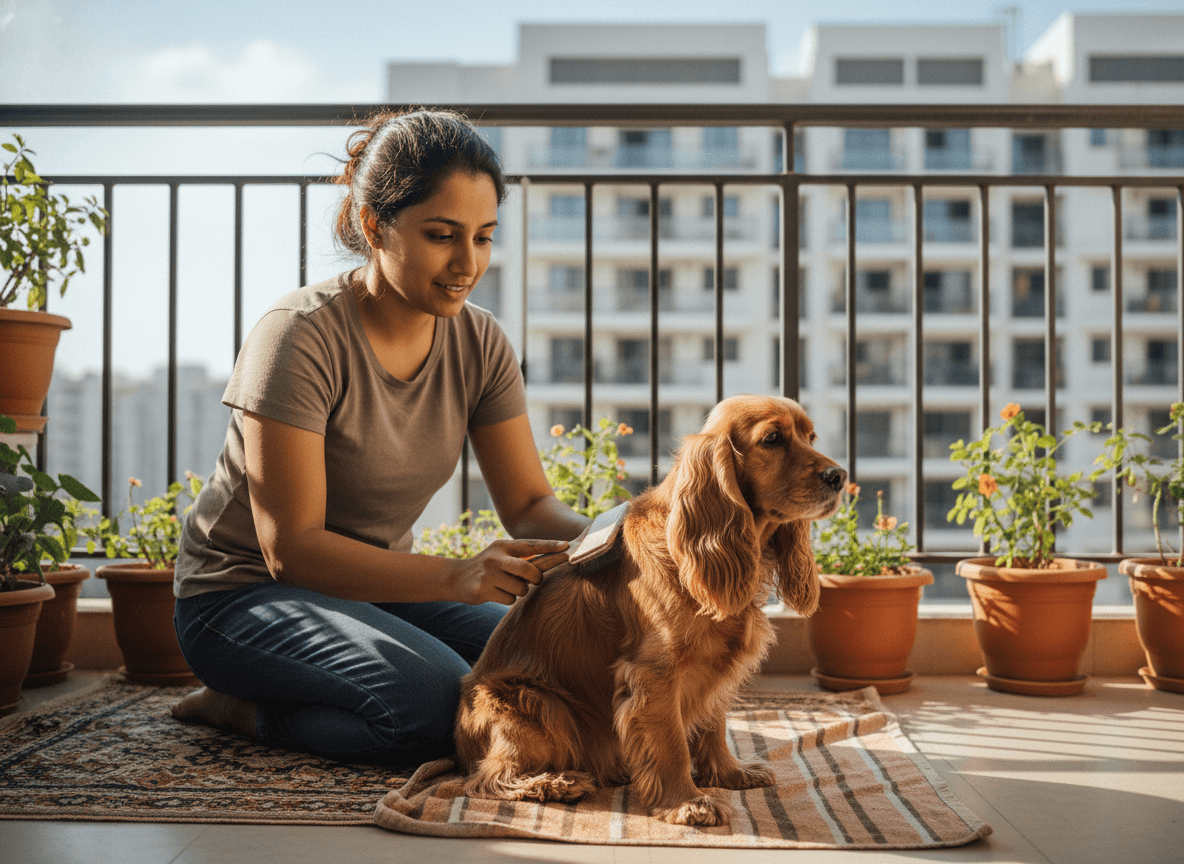
These breeds shed their undercoat twice a year, and in India the summer shed is intense. A FURminator (\u20b91,500\u2013\u20b92,500 depending on size at Heads Up For Tails or Supertails) makes a real difference \u2014 it removes undercoat without cutting guard hairs. Daily brushing during the two-week shed peak reduces loose fur in your home and, more importantly, prevents the matted undercoat that traps moisture against the skin. Matted undercoat in monsoon is a recipe for hot spots.
Bathing schedule: every 7\u201310 days in summer, every 10\u201314 days in monsoon (but thorough drying after every walk). Never skip the blow-dry step for these breeds.
Long-Coated Breeds (Shih Tzu, Lhasa Apso, Maltese)
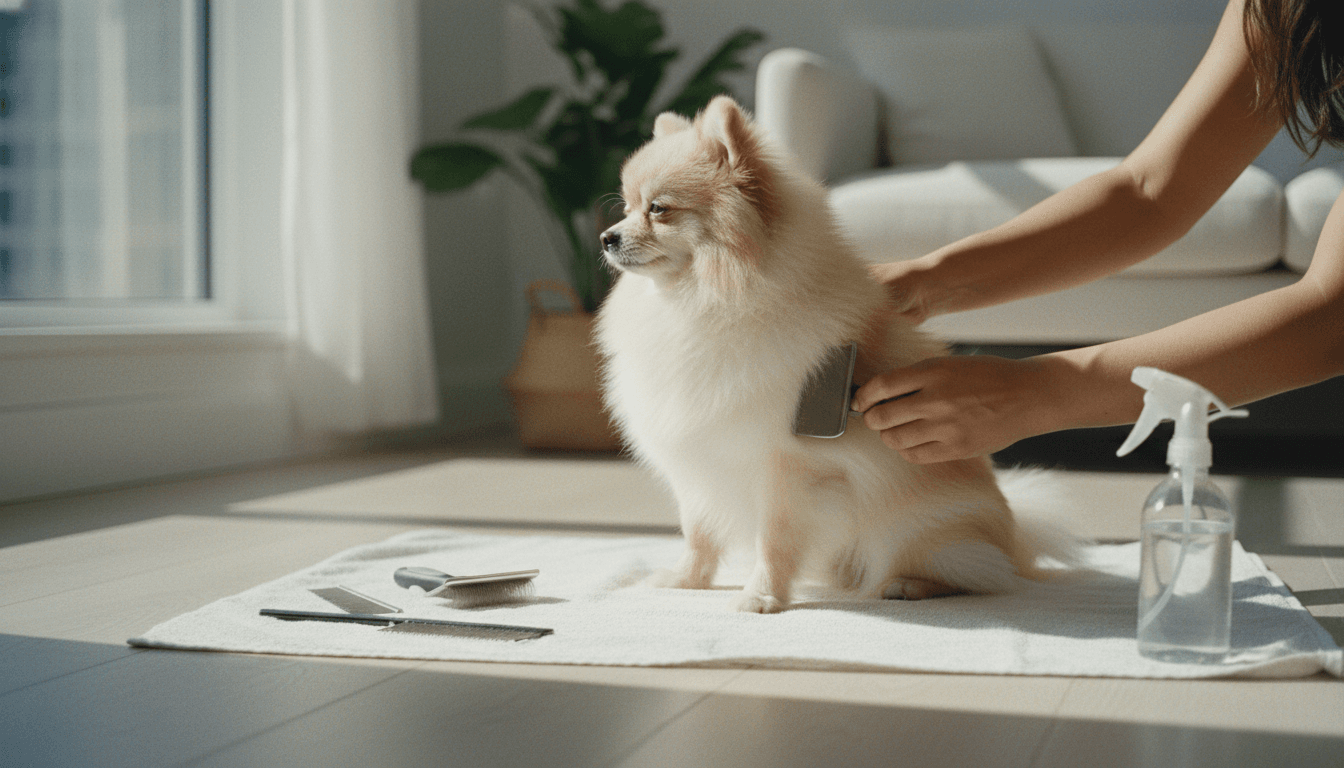
Professional grooming every 6\u20138 weeks is not optional for these breeds in India. The hair around eyes (to prevent corneal scratching), the sanitary area, and the paw pads all need trimming that requires proper clippers. Between professional visits, daily brushing with a pin brush followed by a metal comb catches mats before they tighten. A detangling spray (Petswag or Isle of Dogs, \u20b9350\u2013\u20b9600) makes this easier and prevents coat breakage.
Wrinkle-Faced Breeds (Pug, Bulldog, French Bulldog)
These breeds suffer the most in Indian summers and monsoons. The skin folds trap moisture, sweat, and debris, and in 85% humidity they become breeding grounds for bacteria and yeast. Clean every fold daily with pet-safe wipes, dry completely, and apply a light dusting of cornstarch or vet-prescribed antifungal powder to keep them dry. Vetic's clinics in Delhi and Bangalore see a consistent spike in fold dermatitis cases in July and August.
Indian Pariah Dogs (Indies)
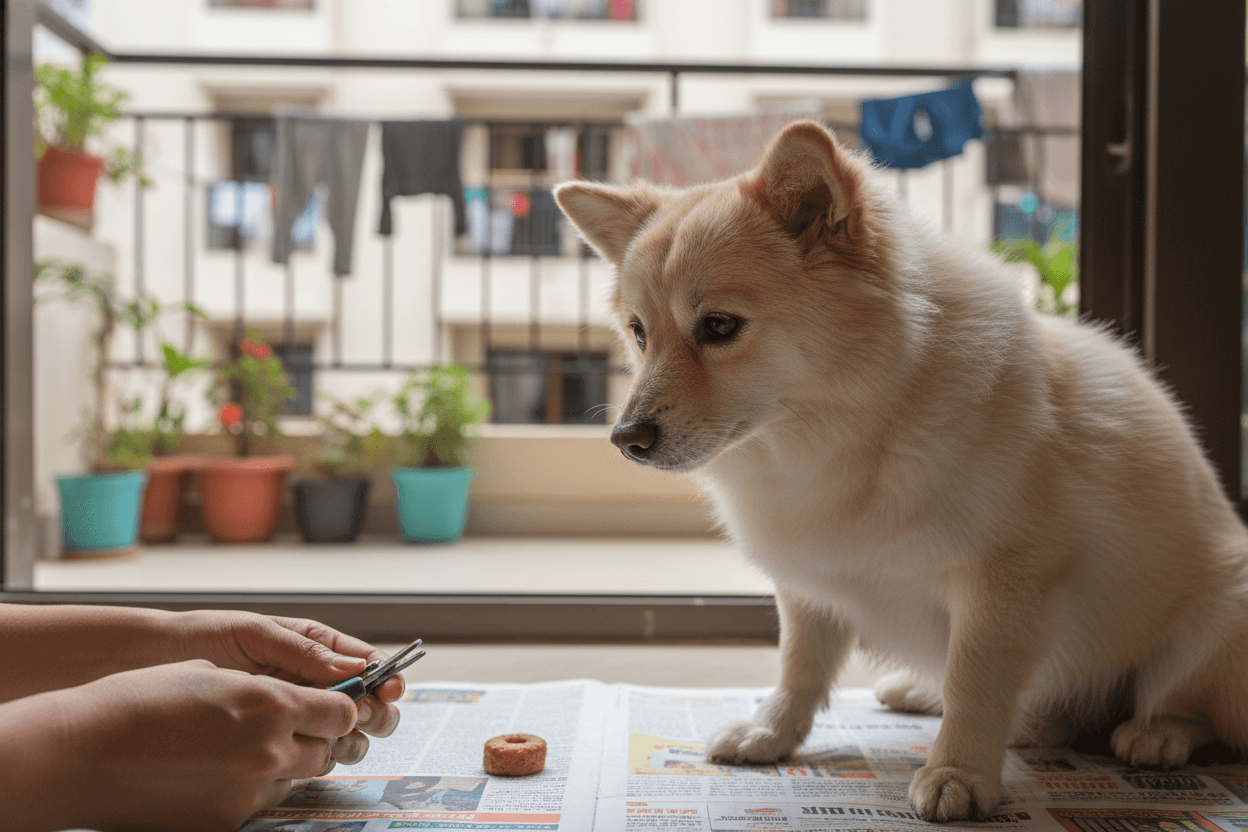
Indies are remarkably well-adapted to Indian conditions. Their short, dense coat manages heat well and dries quickly. Monthly baths are sufficient in most climates. What they still need: regular tick checks (they roam more, pick up ticks more), nail trimming if they're indoor dogs without natural wear, and ear inspection. Their natural immunity to common fungal issues means less intervention, not zero intervention.
| Breed Type | Brushing Frequency |
|---|---|
| Double-coated (GSD, Golden) | Daily during shed, 3x/week otherwise |
| Long-coated (Shih Tzu, Lhasa) | Daily mandatory |
| Wrinkle-faced (Pug, Bulldog) | 3x/week + daily fold cleaning |
| Short-coated (Indie, Beagle) | 2\u20133x/week |
| Floppy-eared (Cocker, Basset) | 3x/week |
| Breed Type | Bath Frequency (Summer) | Key Monsoon Risk |
|---|---|---|
| Double-coated (GSD, Golden) | Every 7\u201310 days | Matted undercoat \u2192 hot spots |
| Long-coated (Shih Tzu, Lhasa) | Every 7 days | Mat-trapped moisture \u2192 skin infection |
| Wrinkle-faced (Pug, Bulldog) | Every 5\u20137 days | Fold dermatitis |
| Short-coated (Indie, Beagle) | Every 10\u201314 days | Tick infestation |
| Floppy-eared (Cocker, Basset) | Every 7\u201310 days | Otitis externa (ear infection) |
Professional Grooming in India: What to Pay, What to Expect
Professional grooming costs vary significantly between cities. In Bangalore, a basic bath and brush for a medium-sized dog at a reputable parlour like Just Dogs or local independent groomers runs \u20b9600\u2013\u20b9900. In Mumbai, expect \u20b9800\u2013\u20b91,200 for the same. A full groom with haircut for a Shih Tzu or Lhasa Apso: \u20b91,400\u2013\u20b92,200 in Bangalore, \u20b91,800\u2013\u20b92,800 in South Delhi or Bandra. De-shedding treatments for heavy-coated breeds: \u20b9900\u2013\u20b91,800 depending on dog size.
What's genuinely worth paying for vs. doing at home? Pay for: breed-specific cuts requiring clippers, de-matting severely tangled coats, first-time nail grind (so you can see the technique), and any anal gland expression your vet recommends. Do at home: all brushing, regular baths, ear cleaning, tooth brushing, and paw care. Learning basic home grooming techniques saves \u20b9500\u2013\u20b91,500 per month for most owners.
One flag for Indian dog owners: monsoon months (July\u2013August) are when grooming parlours get busiest. Book appointments 2\u20133 weeks out, especially for long-coated breeds that need regular trimming to manage moisture.
Essential Tools for Indian Conditions
The basic kit you actually need differs from what Western grooming guides recommend. India-specific additions matter.
| Tool | Purpose | Approx. India Price |
|---|---|---|
| Slicker brush | General brushing, mat detection | \u20b9350\u2013\u20b9700 |
| Undercoat rake / FURminator | De-shedding double-coated breeds | \u20b9700\u2013\u20b92,500 |
| Microfiber towels (2\u20133) | Post-walk and post-bath drying | \u20b9400\u2013\u20b9800 |
| Pet blow-dryer (low heat) | Complete drying in monsoon for long coats | \u20b92,000\u2013\u20b93,500 |
| Virbac Episoothe shampoo | Sensitive skin, oatmeal formula | \u20b9335 (200 ml) |
| Virbac Ketochlor / Himalaya Erina-EP | Anti-fungal / antiparasitic | \u20b9170\u2013\u20b9356 |
| Ear cleaner (Cliny) | Monsoon ear care | \u20b9450 |
| Paw balm (Pet Head / Petbarn) | Summer paw protection | \u20b9350\u2013\u20b9600 |
| Antifungal powder | Fold dermatitis prevention (vet-advised) | \u20b980\u2013\u20b9200 |
| Tick removal tool | Safe tick extraction | \u20b9200\u2013\u20b9400 |
Where to buy: Heads Up For Tails (online and offline in major cities), Supertails, Petsy.online, Amazon.in. For medicated shampoos, your vet's dispensary is usually the most reliable source \u2014 and cheaper than retail for repeat purchases.
Winter and Post-Monsoon Grooming
North India gets real winters. Delhi drops to 5\u20138\u00b0C in January. If you've trimmed your dog's coat aggressively in summer, start letting it grow back by October. Short-coated breeds like Indies, Dachshunds, and Greyhounds feel the cold noticeably and benefit from a sweater during morning walks. Reduce bathing to every 14\u201321 days in winter (Delhi, Punjab, Rajasthan) to avoid dry skin.
Post-monsoon tick season (October\u2013November) is often worse than monsoon itself in parts of Bangalore and Hyderabad. Continue monthly spot-on treatment and check for ticks daily until temperatures drop below 15\u00b0C consistently. At Cessna Lifeline in Bangalore, tick fever cases peak in October\u2013November \u2014 so this window matters.
South India and coastal cities don't really have a winter grooming shift. In Chennai, Kochi, and Hyderabad, the post-monsoon schedule just means drier conditions and slightly less frequent baths. Parasite prevention and regular nail trimming continue year-round.
Grooming Mistakes That Cost Indian Dog Owners Real Money
Based on what I've seen in Indian dog owner communities and what vets report, five grooming errors dominate.
Shaving double-coated breeds in summer. Covered above \u2014 it backfires. The coat regrows in an altered texture and may never fully recover proper insulating structure. Trim, don't shave.
Letting coats air-dry in monsoon. A three-kilogram Shih Tzu with a full coat can stay technically damp for 4\u20136 hours after a towel-dry in 90% humidity. That's enough time for a hot spot to form. Budget 15 minutes with a pet dryer.
Using human shampoos. Dog skin pH sits around 7.5 compared to human skin at 5.5. Human shampoos \u2014 even 'gentle' or 'baby' formulations \u2014 disrupt the skin's acid mantle and increase susceptibility to bacterial infections. This mistake leads to a cycle of bathing that makes things worse, not better.
Ignoring dental care. Around 80% of dogs over three years have periodontal disease, according to the American Veterinary Medical Association. Professional dental cleaning at an Indian vet hospital costs \u20b95,000\u2013\u20b915,000 under anaesthesia. Brushing 3\u20134 times a week with dog-specific toothpaste (Virbac C.E.T., \u20b9280) costs less and prevents the need for most cleanings.
Skipping the ear cleaning routine for dogs. In a country with 5\u20136 humid months per year, routine ear cleaning is non-negotiable for floppy-eared breeds. Caught early, ear infections are a quick fix. Left untreated, they become chronic and sometimes require surgery.
Seasonal Grooming Calendar for India
| Task | Summer (Mar\u2013Jun) | Monsoon (Jun\u2013Sep) |
|---|---|---|
| Bath frequency | Weekly or every 10 days | Every 10\u201314 days |
| Shampoo type | Mild/oatmeal | Antifungal rotation |
| Coat brushing | Daily (double coat), 3x/week others | Daily \u2014 prevents mat-trapping moisture |
| Ear cleaning | Weekly | Every 5\u20137 days |
| Paw check & care | After every walk | After every walk |
| Tick/flea prevention | Monthly spot-on | Monthly + daily tick check |
| Task | Post-Monsoon (Oct\u2013Nov) | Winter (Dec\u2013Feb) |
|---|---|---|
| Bath frequency | Every 10\u201314 days | Every 14\u201321 days |
| Shampoo type | Regular | Moisturizing |
| Coat brushing | 3x/week | 3x/week |
| Ear cleaning | Weekly | Weekly |
| Paw check & care | After every walk | After every walk |
| Tick/flea prevention | Monthly + daily check | Monthly |
When to See a Vet, Not a Groomer
Groomers are not vets. These signs need a vet appointment, not a bath:
- Hot spots: red, moist, inflamed patches, often self-traumatized from scratching. Left 24 hours, they spread quickly.
- Patchy hair loss with scaling skin \u2014 could be ringworm, mange, or hormonal.
- Any ear with black or dark brown discharge, strong odour, or swelling around the canal.
- Paw pads with cracks that bleed, lumps, or swelling between toes.
- Skin with a distinctly musty or 'corn chip' odour despite recent bathing.
Vet consultation in India runs \u20b9300\u2013\u20b9800 depending on the city and clinic. At Vetic in Delhi or Bangalore, skin consultation with a follow-up plan typically comes in at \u20b9500\u2013\u20b9700. Catching a fungal infection early costs under \u20b91,500 in treatment. Missing it costs \u20b93,000\u2013\u20b910,000 and three weeks of your dog's discomfort.
Grooming for Indian Apartment Living
Most Indian dog owners in cities live in 1\u20133 BHK apartments without garden access. That changes grooming logistics. You're bathing in a bathroom, not a yard. Your dog has limited space to shake dry. Neighbours below you will hear a blow-dryer at 7 PM.
A few things that make apartment grooming work: a non-slip bath mat in the tub or shower stall (dogs panic less on stable footing), a handheld showerhead attachment for rinsing, and a grooming arm clip if you're doing complex brushing on a table. A microfiber quick-dry robe for your dog (\u20b9500\u2013\u20b9900) cuts blow-dry time in half for medium-sized breeds.
For grooming tools that work in Indian homes and apartments, space and noise are real constraints. Cordless clippers and quiet pet dryers matter more here than they do in houses with yards.