Key Takeaways
- Rottweiler appeared on India's 2024 draft ferocious breed list; Doberman did not, giving Doberman owners a measurable legal advantage in urban housing societies
- DCM affects up to 58% of European Dobermans by age 8; Rottweilers carry a 20.1% hip dysplasia rate and approximately 12.4% lifetime osteosarcoma risk
- 10-year total ownership cost: Doberman approximately Rs 8-12 lakh vs Rottweiler Rs 12-18 lakh across Indian metros at 2026 prices
- KCI-registered Doberman puppies sell for Rs 35,000-80,000; Rottweilers Rs 50,000-1,20,000. Any 'German import Rottweiler' below Rs 1,00,000 without verifiable ADRK papers is almost certainly misrepresented
- Doberman suits urban apartments and personal protection work; Rottweiler suits independent properties with perimeter space and an experienced prior large-dog owner
Two Power Breeds, Very Different Legal Profiles
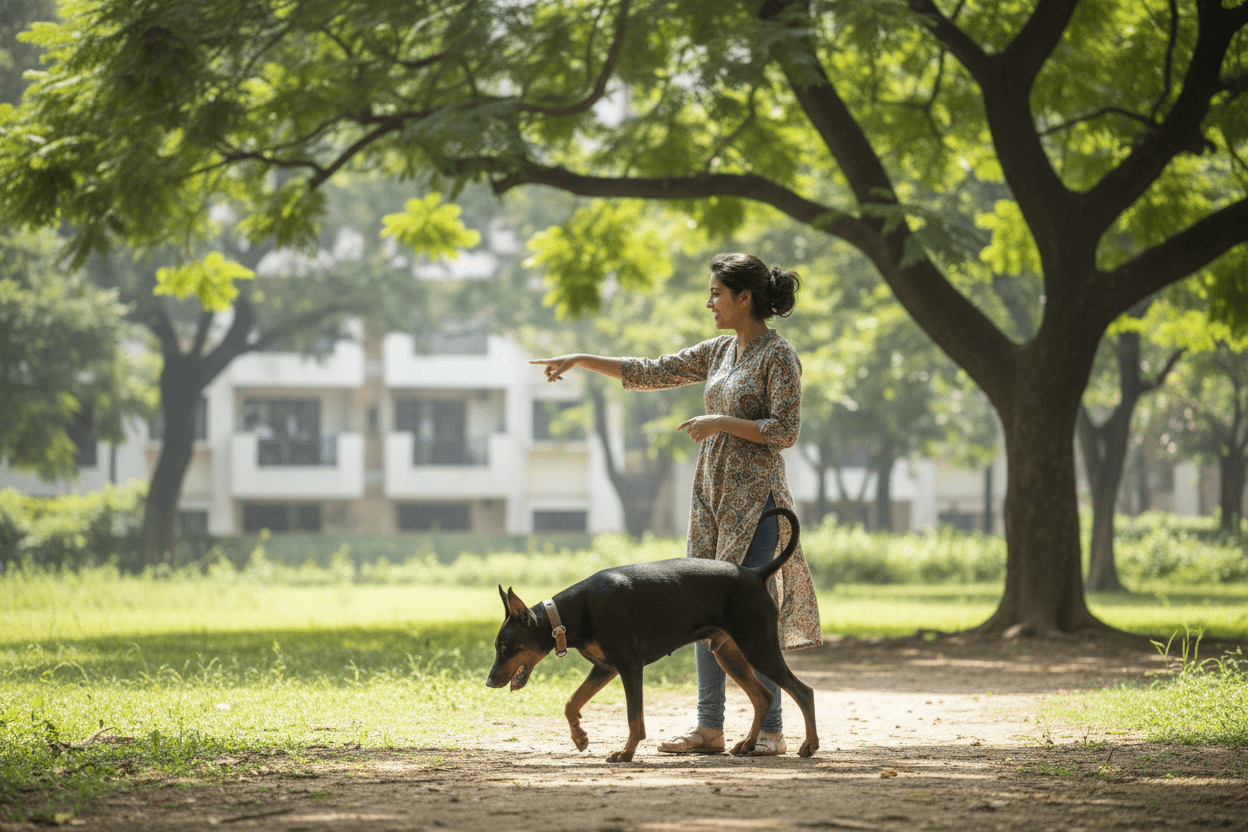
Both the Rottweiler and the Doberman Pinscher attract Indian buyers for the same reasons: size, loyalty, and a genuine deterrent presence. The comparison stops there. These two breeds carry drastically different legal statuses, health timelines, and ownership costs in the Indian context.
A Rottweiler male weighs 43-61 kg and ranks #9 in canine intelligence according to the American Kennel Club. A Doberman male weighs 32-45 kg and ranks #5. That 15 kg difference shapes everything from monthly food bills to housing society bylaws to professional trainer preferences.
This guide gets specific: rupee figures, city-level legal risk, actual health failure rates, and a clear verdict for your living situation.
For more on pariah live apartments? flat, see our pariah live apartments? flat guide.
Learn more in our detailed large breeds resource.
The 'Ferocious Breed' Notification: How Indian Law and Housing Societies Target Both Breeds Differently
India's Ministry of Agriculture issued a draft notification in 2024 listing 23 breeds as 'ferocious.' Rottweiler made the list. Doberman did not. That single bureaucratic distinction has downstream consequences most Indian buyers never research before purchasing.
Housing societies in Delhi NCR, Mumbai, Pune, and Navi Mumbai have implemented breed-specific bylaws under the Maharashtra Co-operative Societies Act and equivalent state laws. Rottweilers appear in these restrictions far more frequently than Dobermans. If you live in a gated community or plan to move into one, Doberman ownership avoids a category of legal friction that Rottweiler owners now face routinely.
Courts have pushed back. The Delhi High Court and Bombay High Court have both ruled that blanket breed bans without individual behavioural assessment aren't automatically enforceable under the Prevention of Cruelty to Animals Act. Winning that argument still costs Rs 50,000-2,00,000 in lawyer fees and takes months. Navi Mumbai Municipal Corporation and Noida Authority have issued Rottweiler-specific advisories requiring registration and third-party liability insurance, with no comparable requirement for Doberman owners.
Under Section 289 of the Indian Penal Code, negligent handling of an animal that endangers human life is a punishable offence. A bite incident, regardless of provocation, can trigger criminal liability. Rottweiler bites register approximately 328 PSI; Doberman bites approximately 245 PSI. That structural difference in damage potential increases legal exposure severity for Rottweiler owners significantly. According to the Animal Welfare Board of India, both breeds require responsible containment and socialisation to meet existing animal welfare guidelines.
For more on labrador golden retriever, see our labrador golden retriever guide.
For more on independent houses, see our independent houses guide.
Ear Cropping and Tail Docking: India's Illegal but Thriving Underground Market for Both Breeds
The Animal Welfare Board of India's 2010 circular explicitly condemns ear cropping and tail docking as cosmetic procedures causing unnecessary pain under Section 11 of the Prevention of Cruelty to Animals Act 1960. Both procedures are illegal in India without medical justification. Both are openly performed.
Doberman ear cropping is advertised on social media and via informal veterinary networks in Punjab, Delhi, Haryana, and UP. Prices range from Rs 3,000 to Rs 10,000 depending on style: show crop, battle crop, or pet crop. Buyers request it as an aesthetic preference despite it having zero functional benefit for a modern companion dog.
Rottweiler tail docking is typically performed at 3-5 days of age by breeders, before puppies are even advertised for sale. Many buyers receive a docked Rottweiler without realising the modification was illegal. Germany banned Rottweiler tail docking in 1987. The ADRK, the official German Rottweiler breed registry since 1907, requires undocked tails for registration. Any breeder claiming authentic ADRK bloodlines while presenting docked puppies is almost certainly misrepresenting the animal's lineage.
Post-operative complications from illegal ear cropping performed by unregistered practitioners include haematoma, wound infection, keloid scarring, and bilateral ear asymmetry. Corrective veterinary treatment costs Rs 5,000-20,000. Unsterilised instruments used in informal settings carry risk of parvovirus, distemper, and bacterial infection. A docked Rottweiler sold as 'German import quality' is an automatic red flag: authentic ADRK-certified dogs never have docked tails.
For more on breeds, see our breeds guide.
Learn more in our detailed heat tolerance resource.
Rottweiler vs Doberman: Key Facts for Indian Buyers (2026)
| Factor | Rottweiler | Doberman |
|---|---|---|
| Adult male weight | 43-61 kg | 32-45 kg |
| AKC intelligence rank | #9 | #5 |
| ATTS temperament pass rate (2023) | 84.7% | 79.1% |
| On India 2024 draft ferocious breed list | Yes | No |
| Hip dysplasia rate (OFA data) | ~20.1% | Not OFA-tracked |
| Lifetime osteosarcoma risk | ~12.4% | Lower |
| DCM (heart disease) risk | Lower | Up to 58% by age 8 |
| Average lifespan | 8-10 years | 10-13 years |
| Monthly food cost (metro, premium kibble) | Rs 5,500-9,000 | Rs 4,000-6,500 |
| Summer AC cost addition (peak months) | Rs 3,000-5,000/month | Lower (single coat) |
| 10-year total ownership estimate | Rs 12-18 lakh | Rs 8-12 lakh |
| KCI-registered puppy price | Rs 50,000-1,20,000 | Rs 35,000-80,000 |
| Preferred by security professionals for | Estate perimeter guarding | Personal/close protection |
| Housing society legal risk (Tier-1 cities) | High | Low-moderate |
| KCI registration growth (2023-2026) | ~8% | ~18% |
The Health Timebombs Indian Owners Don't Test For: DCM, Bone Cancer, GDV, and Hip Failure
Both breeds carry serious hereditary health risks. Most Indian buyers discover these risks after purchase, not before. The screening tests exist, the costs are manageable, and almost nobody uses them.
Dilated cardiomyopathy (DCM) affects an estimated 50-58% of European Dobermans by age 8, according to PetMD's Doberman health profile. The disease is clinically silent until collapse or sudden death. Cardiac echocardiogram screening is available in Mumbai (Bombay Veterinary College), Delhi (IVRI), Bangalore, and Hyderabad for Rs 3,000-8,000 per session. Fewer than an estimated 5% of Indian Doberman owners screen annually.
Rottweilers face a different threat: osteosarcoma (bone cancer) affects approximately 12.4% in their lifetime, one of the highest rates of any breed. The cancer is aggressive, with median survival of 6-12 months post-diagnosis even with amputation and chemotherapy. Chemotherapy protocols at oncology-capable vet hospitals in India cost Rs 30,000-80,000 per course. The Orthopedic Foundation for Animals documents Rottweilers at approximately 20.1% hip dysplasia incidence. Hip replacement at specialist centres in Mumbai, Delhi, and Bangalore costs Rs 80,000-1,50,000 per hip. Most Indian owners, unaware of this cost horizon, choose pain management at Rs 2,000-5,000 per month instead.
Gastric Dilatation-Volvulus (GDV, or bloat) is a life-threatening emergency for Rottweilers' deep-chested body shape. Surgery must happen within 1-6 hours of onset. Emergency GDV surgery costs Rs 40,000-80,000 at specialist Indian veterinary hospitals in Mumbai, Delhi, Bangalore, Hyderabad, and Chennai. Prophylactic gastropexy at the time of spay or neuter reduces GDV risk by over 90% and costs Rs 8,000-20,000 in India. It's almost never offered proactively by Indian vets.
Dobermans carry their own blood disorder: von Willebrand disease affects approximately 25% of the breed. During routine spay or neuter, undiagnosed vWD can cause life-threatening haemorrhage. DNA testing for vWD is available in India for Rs 5,000-10,000 via Embark or Wisdom Panel kits, including international shipping.
For more on prices, see our prices guide.
India's Protection Dog Economy: Which Breed Professional Security Trainers Actually Deploy
India's private security industry is valued at over Rs 70,000 crore in 2025, employing more than 9 million personnel. The top-tier K9 sector is dominated by German Shepherds and Belgian Malinois for government contracts. When the field narrows to private estate and celebrity protection, Dobermans are the clear preference.
Speed and agility drive this choice. A Doberman sprints at approximately 32 km/h versus a Rottweiler's 25 km/h. Dobermans are lighter, faster to redirect, and safer to control physically in crowded urban environments. A professionally trained personal protection Doberman with Schutzhund or IPO title costs Rs 2,00,000-8,00,000 in India.
Rottweilers fill a different role entirely. Their size, lower centre of gravity, and natural wait-and-intimidate territorial instinct make them more effective as perimeter deterrents on static properties. Agricultural farms, industrial compounds, and warehouses in Maharashtra, Rajasthan, and Gujarat routinely deploy Rottweilers as overnight guards. They're slower to mobilise but a more credible visual deterrent at a fence-line.
CISF, BSF, and state police K9 units primarily use German Shepherds, Labradors, and Belgian Malinois. Neither Rottweiler nor Doberman appears in standard government K9 procurement specifications, with both considered too liability-prone for law enforcement contexts in India.
Schutzhund and IPO protection sport clubs operate in approximately 15-20 locations across India, primarily Delhi, Mumbai, Pune, Hyderabad, and Bangalore. Dobermans outnumber Rottweilers in Indian IPO competition registrations by roughly 3:1, reflecting their agility advantage in bite work exercises and better heat tolerance during outdoor trials.
For more on foreign breeds — 12-point comparison, see our foreign breeds — 12-point comparison guide.
For more on breeds hot climates — heat-tolerant, see our breeds hot climates — heat-tolerant guide.
What Power Breed Ownership Actually Costs in India: 2026 Monthly Breakdown
Rottweiler adult male in Mumbai or Delhi (peak summer, March-June): Royal Canin Large Adult at Rs 380/kg, 600g/day = Rs 6,840/month food. Add preventive vet baseline Rs 1,500/month, dedicated AC running cost Rs 3,000-5,000/month, professional trainer Rs 2,000-4,000/month. Monthly total during summer: Rs 13,340-17,340. Doberman adult male in the same cities: 500g/day premium kibble = Rs 5,700/month food. Preventive vet baseline Rs 1,200/month, lower AC overhead from single coat, trainer Rs 1,500-3,000/month. Monthly total during summer: Rs 8,400-9,900. Annual preventive care baseline for either breed (core vaccines, deworming, flea and tick prevention, dental cleaning): Rs 15,000-30,000. Budget separately for annual DCM cardiac echo if Doberman (Rs 3,000-8,000 from age 3) and hip X-rays if Rottweiler (Rs 2,000-6,000 annually). For more on breeds — native breeds, see our breeds — native breeds guide. For more on prices, see our prices guide.
KCI Registration Fraud and the Import Certificate Scam: How Indian Buyers Get Deceived
A genuine Kennel Club of India litter registration certificate costs Rs 500-1,500 and is verifiable at kennelclubindia.org. Fraudulent breeders sell fake certificates for Rs 5,000-15,000 to justify inflated puppy prices. Before paying any deposit, verify the registration number through the KCI database. The check takes five minutes and costs nothing.
Unregistered Rottweiler puppies in India sell for Rs 15,000-40,000. KCI-registered puppies from proven Indian bloodlines: Rs 50,000-1,20,000. Genuine ADRK German imports with verifiable papers: Rs 1,50,000-2,50,000 landed in India. Any 'German import Rottweiler' offered below Rs 1,00,000 with unverifiable paperwork is almost certainly misrepresented.
Unregistered Doberman puppies sell for Rs 10,000-30,000. KCI-registered: Rs 35,000-80,000. Czech or Slovak working-line imports with FCI papers: Rs 1,00,000-2,50,000. Mixed-blood 'Doberman types' crossed with local dogs for cost reduction are routinely sold as purebreds in rural and semi-urban markets across India.
DNA ancestry testing via Embark or Wisdom Panel runs Rs 8,000-15,000 including international shipping and screens over 200 genetic health conditions, including DCM gene variants in Dobermans and hip dysplasia markers in Rottweilers. For any puppy lacking verified papers, a DNA test is the most useful verification you can commission.
Physical red flags for mixed-blood Rottweilers sold in India: yellow or amber eyes (purebreds have dark brown), tan markings extending above the eyebrow dots, wavy or overly long coat, extreme frame above 70 kg. Red flags for Dobermans sold as purebred: excessively blocky head, very short neck, any colour outside black-rust, red-rust, blue-rust, or fawn-rust. According to AKC Rottweiler breed standards, these physical deviations indicate mixed ancestry regardless of what any certificate claims.
Human Aggression Risk and Temperament: Honest Data for the Indian Joint-Family Household
The American Temperament Test Society's 2023 data gives Rottweilers an 84.7% pass rate and Dobermans 79.1%. The all-breed average sits at 83-85%. A Rottweiler actually tests slightly more stable than a Doberman under standardised conditions. ATTS tests are conducted in Western environments, however, and Indian-specific stimuli such as Diwali firecrackers, crowded markets, motorcycles, cattle, and domestic workers entering the home create socialisation challenges not captured in Western protocols.
Male Rottweilers typically exhibit dominance-aggression onset at 18-36 months. This phase shocks Indian owners who purchased a gentle puppy. Consistent correction from a confident, experienced handler during this window is non-negotiable. Owners who can't establish a clear hierarchy face significantly elevated rehoming or incident rates.
Dobermans exhibit intense single-owner bonding, fiercely loyal to the primary handler but potentially suspicious or territorial toward other household members. In Indian joint-family setups with grandparents, in-laws, and domestic staff sharing a home, this bonding pattern demands deliberate early socialisation with every household resident beginning at 8 weeks.
The critical socialisation window for both breeds closes at approximately 12-14 weeks. A common practice in India is keeping puppies in complete isolation until full vaccination at 12-16 weeks, entirely missing this window. Veterinary behaviourists identify missed socialisation as the primary driver of fear-based aggression in adult power breeds across Indian cities.
Both breeds are explicitly classified 'not suitable for first-time dog owners' in KCI and AWBI breed guidance. Professional Indian trainers don't recommend either breed as a family pet without prior large-dog experience, a secure living environment, and a committed minimum 90-minute daily exercise schedule.
For more on german shepherd labrador india, see our german shepherd labrador india guide.
The 2026 India Verdict: Rottweiler or Doberman Based on Your Actual Living Situation
KCI registration data from 2023-2026 shows Doberman registrations grew approximately 18% while Rottweiler registrations grew approximately 8%. The divergence reflects Doberman's cleaner legal profile, better urban heat adaptation, and growing middle-class preference for agile, highly trainable protection dogs over heavy guarding breeds. For urban apartment dwellers in Mumbai, Delhi, Bangalore, and Hyderabad: Doberman is the stronger fit by a wide margin. Smaller footprint, 30-40% better heat tolerance, faster obedience response (ranked #5 intelligence versus Rottweiler's #9), and significantly lower housing society legal risk given the breed's absence from India's ferocious-breed draft notification. For independent houses, farmhouses, and semi-urban or rural properties with outdoor space: Rottweiler provides superior deterrent presence. Their natural territorial behaviour suits Indian property guarding well. Rottweilers are also less likely to escape containment: Dobermans can clear 6-foot fences and are noted escape artists requiring higher-security fencing. The 10-year total cost comparison at 2026 prices: Doberman approximately Rs 8-12 lakh (purchase, food, vet, training); Rottweiler approximately Rs 12-18 lakh. The Rottweiler premium reflects higher daily food volume, greater vet bills from hip dysplasia and osteosarcoma, a shorter average lifespan of 8-10 years versus Doberman's 10-13 years, and higher cooling infrastructure costs. Final recommendation matrix: Choose Doberman if you're in an apartment or gated community, this is your first large dog, you live in a Tier-1 city with RWA restrictions, your 10-year budget is under Rs 10 lakh, or your primary goal is personal protection. Choose Rottweiler if you own an independent property with a perimeter, you've previously owned large breeds, your primary goal is estate deterrence, you're in a semi-urban or rural setting, and your family is fully prepared for the 18-36 month dominance phase.
If you're in Mumbai, costs vary significantly by neighbourhood — Ameya Society, Prabhadevi averages ₹89 while Borla, Union Park, Chembur runs around ₹1,044.