Key Takeaways
- India has approximately 32 million pet dogs, making it the 4th largest dog-owning nation; the pet industry crossed ₹17,000 crore in 2025 at 14.2% CAGR.
- Labrador Retriever has led KCI registration charts for 12 consecutive years; German Shepherd and Golden Retriever hold 2nd and 3rd positions consistently since 2015.
- Over 60% of dogs sold in India come from unregistered breeders or pet shops with no health testing, breed verification, or lineage documentation.
- Indian vets recorded a 340% rise in BOAS surgeries over five years; French Bulldogs require 24/7 air conditioning in any Indian city above 30 degrees Celsius.
- Ten-year ownership cost ranges from ₹1.5 lakh for an INDog to ₹20 lakh for giant breeds; pet insurance covers under 2% of dogs in India.
- AWBI guidelines prohibit housing society breed bans, but enforcement falls on the dog owner and requires filing a formal legal notice.
India's Dog Breed Market: Size, Trends, and the 2026 Ownership Landscape
India crossed the ₹17,000 crore mark in pet industry revenue in 2025, growing at a 14.2% compound annual rate driven primarily by dog food, grooming services, and veterinary care rather than breed purchases alone. The country now has approximately 32 million pet dogs, placing it 4th globally by count, with urban dog ownership surging 31% since the pandemic, according to PetFed India's 2025 market report.
Tier-2 cities are reshaping the ownership map. Jaipur, Lucknow, Coimbatore, and Indore collectively accounted for 38% of new dog adoptions in 2025, overtaking Mumbai and Delhi in growth rate for the first time. This shift brings new veterinary infrastructure challenges because emergency specialty care remains concentrated in the four major metros, leaving owners in cities like Patna and Bhubaneswar facing 4 to 8 hour referral delays for specialist procedures.
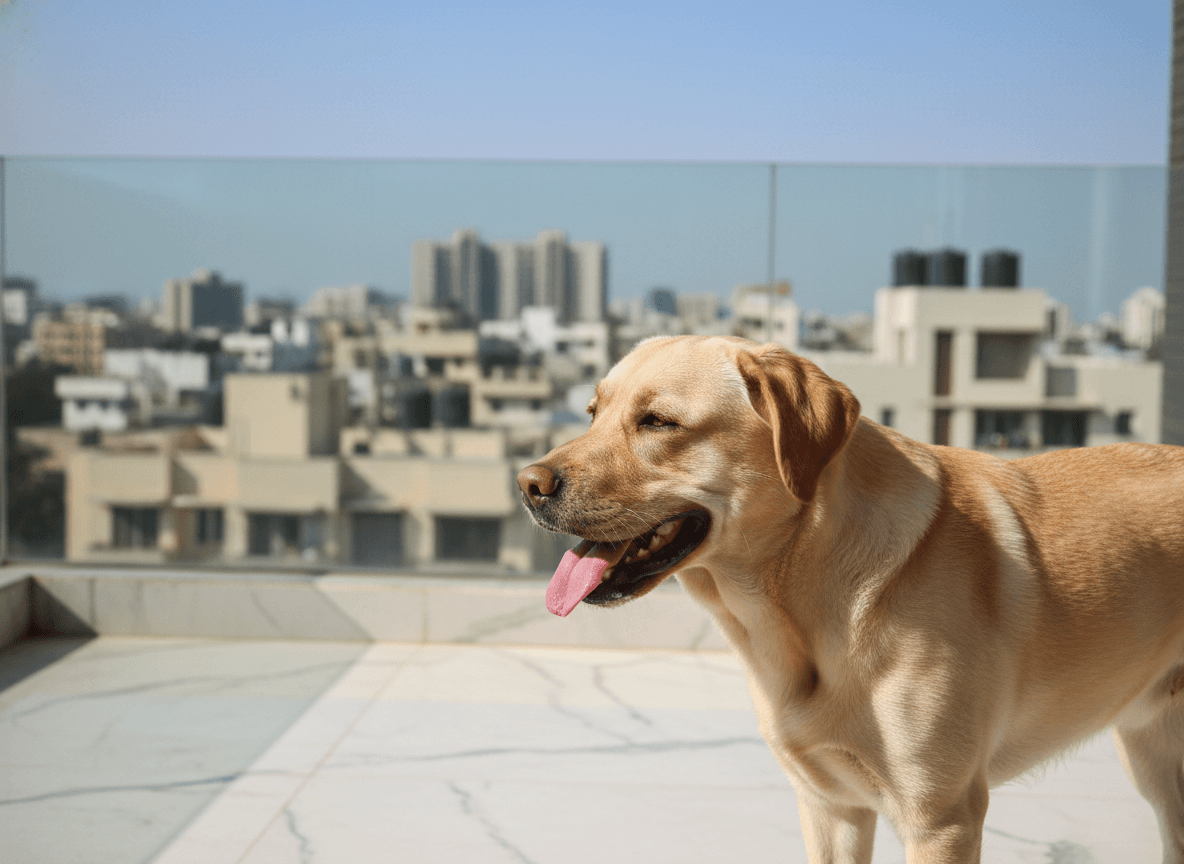
Registration data from the Kennel Club of India tells a consistent story at the top: Labrador Retriever has led KCI charts for 12 consecutive years, with German Shepherd and Golden Retriever firmly holding 2nd and 3rd positions since 2015. Below that top tier, the picture is murkier. Over 60% of dogs sold in India in 2025 came from unregistered backyard breeders or pet shops, meaning no health testing, no lineage verification, and no accountability when medical problems surface at age 3 or 4.
The Indian Pariah Dog, or INDog, sits at the opposite end of the spectrum. With over 30 million free-roaming individuals, INDogs are the most genetically diverse and climate-adapted dog population in the world. Their near-zero disease burden and full adaptation to every Indian climate make them a practical benchmark against which every imported breed should be measured.
For more on foreign breeds — comparison parents, see our foreign breeds — comparison parents guide.
For more on breeds, see our breeds guide.
Small Breeds in Indian Apartments: The Pomeranian, Shih Tzu, and Pug Reality Check
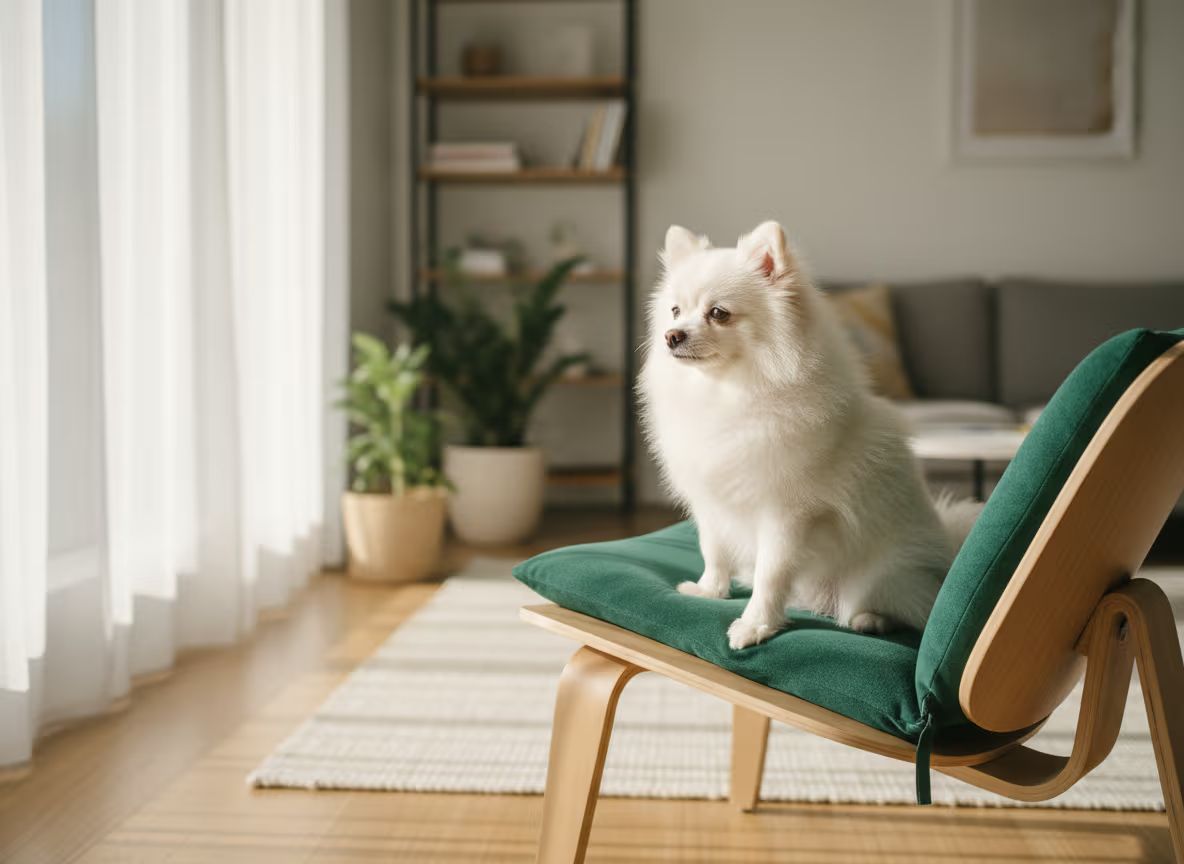
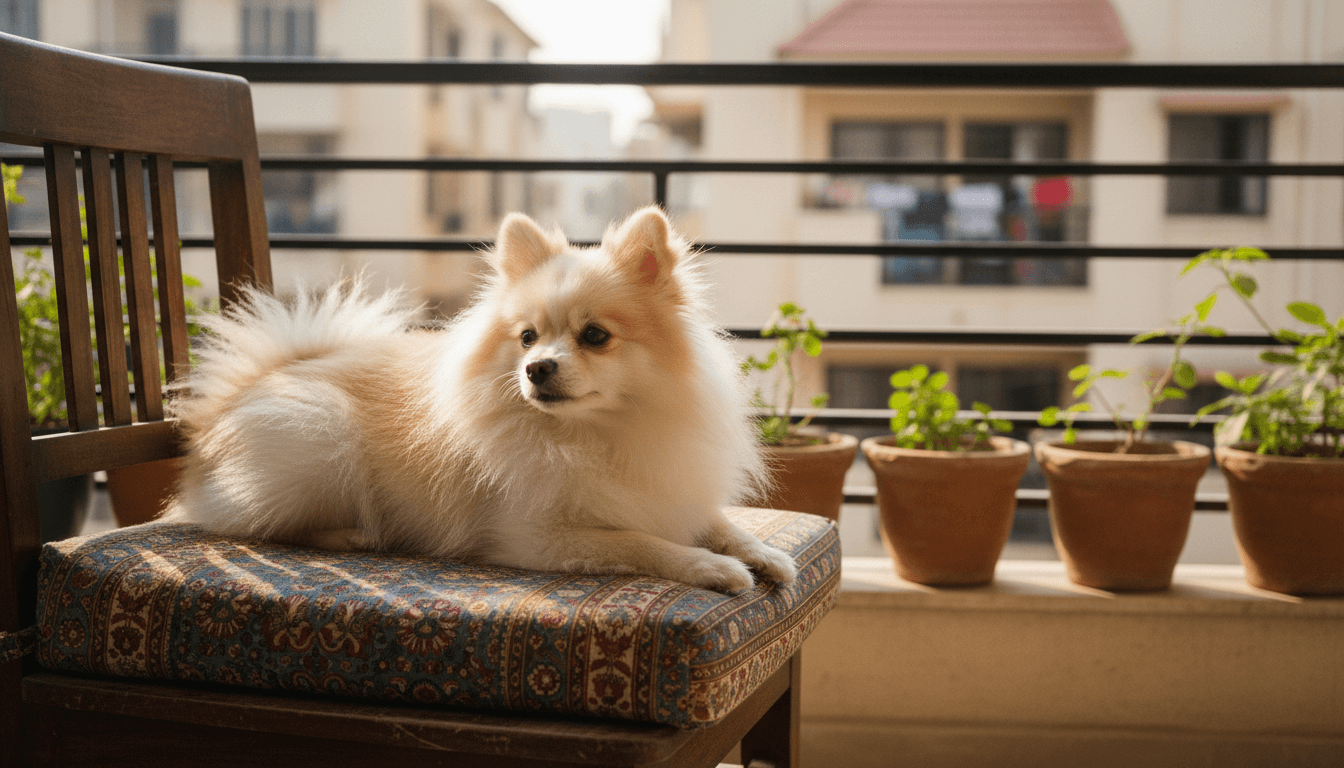
Pomeranian holds the title of most owned small breed in India, selling for ₹3,000 to ₹15,000 from unregistered breeders. The low purchase price masks a serious climate liability: Pomeranians are double-coated and prone to heat exhaustion above 32 degrees Celsius, making them dependent on air conditioning across most Indian cities from March through September.
Shih Tzu prices from reputed breeders range ₹25,000 to ₹50,000. Their flat face and double coat require daily grooming and monthly professional visits costing ₹1,200 to ₹2,500 each, per India Today's 2025 dog breed coverage. Monthly ownership cost for a small breed in India averages ₹4,000 to ₹8,000 covering Royal Canin or Pedigree food (₹2,000 to ₹3,500), grooming, and routine vet care.
Pugs sit in a distinct risk category. Data from the Veterinary Association of India shows pug owners face a 40 to 60% lifetime probability of requiring BOAS surgery, costing ₹25,000 to ₹60,000 at Indian veterinary hospitals. Beagle has become the fastest-growing medium-small breed in Indian metros in 2025, priced ₹20,000 to ₹35,000 KCI registered, though their strong scenting instinct creates apartment escape risk without secure outdoor access.
Two other small breeds deserve specific attention. Dachshunds, popular in Indian flats, carry a 25% lifetime risk of Intervertebral Disc Disease with spinal surgery costs of ₹40,000 to ₹1,20,000 at Indian specialist centers. Lhasa Apso, originally from Tibet's cold climate, adapts reasonably well in AC-equipped northern homes and hill stations and is priced at ₹15,000 to ₹30,000 in India.
For more on labrador golden retriever, see our labrador golden retriever guide.
Brachycephalic Breeds in India's Heat: The Pug, French Bulldog, and English Bulldog Crisis
The numbers from Indian veterinary practice are stark. Between 2019 and 2024, BOAS surgical interventions in Pugs and French Bulldogs increased 340%, directly correlated with social-media-driven demand for flat-faced dogs, per the Veterinary Association India brachycephalic health data. Every brachycephalic breed sold in a hot Indian city is, statistically, a future surgical case.
French Bulldogs reached ₹80,000 to ₹1,50,000 in 2025, making them the most expensive popular breed in India. That purchase price carries a non-negotiable 24/7 air-conditioned environment requirement in any city where summer temperatures exceed 30 degrees Celsius. At 40 degrees Celsius, common in Delhi, Nagpur, and Hyderabad, brachycephalic dogs reach critical heat stress within 15 minutes of outdoor exposure. Emergency vet costs for heat stroke run ₹5,000 to ₹25,000 per incident.
English Bulldogs present a separate problem of supply. Their cesarean delivery rate approaches 100%, and India has no certified Bulldog breeding programs meeting international welfare standards. Any English Bulldog purchased in India was almost certainly born from an unregulated, unlicensed operation.
Coastal cities compound the problem. Pug skin fold infections are 3 times more prevalent in Mumbai, Chennai, and Kochi compared to dry northern cities, adding ₹600 to ₹1,200 per month in medicated washes and fold cleaning. The welfare impact of the Vodafone Hutch Pug advertising campaign from the early 2000s remains measurable today: demand for the breed never returned to pre-campaign levels, and Indian animal welfare groups trace the ongoing BOAS surgical crisis directly to that marketing moment.
For more on breeds, see our breeds guide.
Large Guard Breeds in India: German Shepherd, Rottweiler, and Doberman Economics
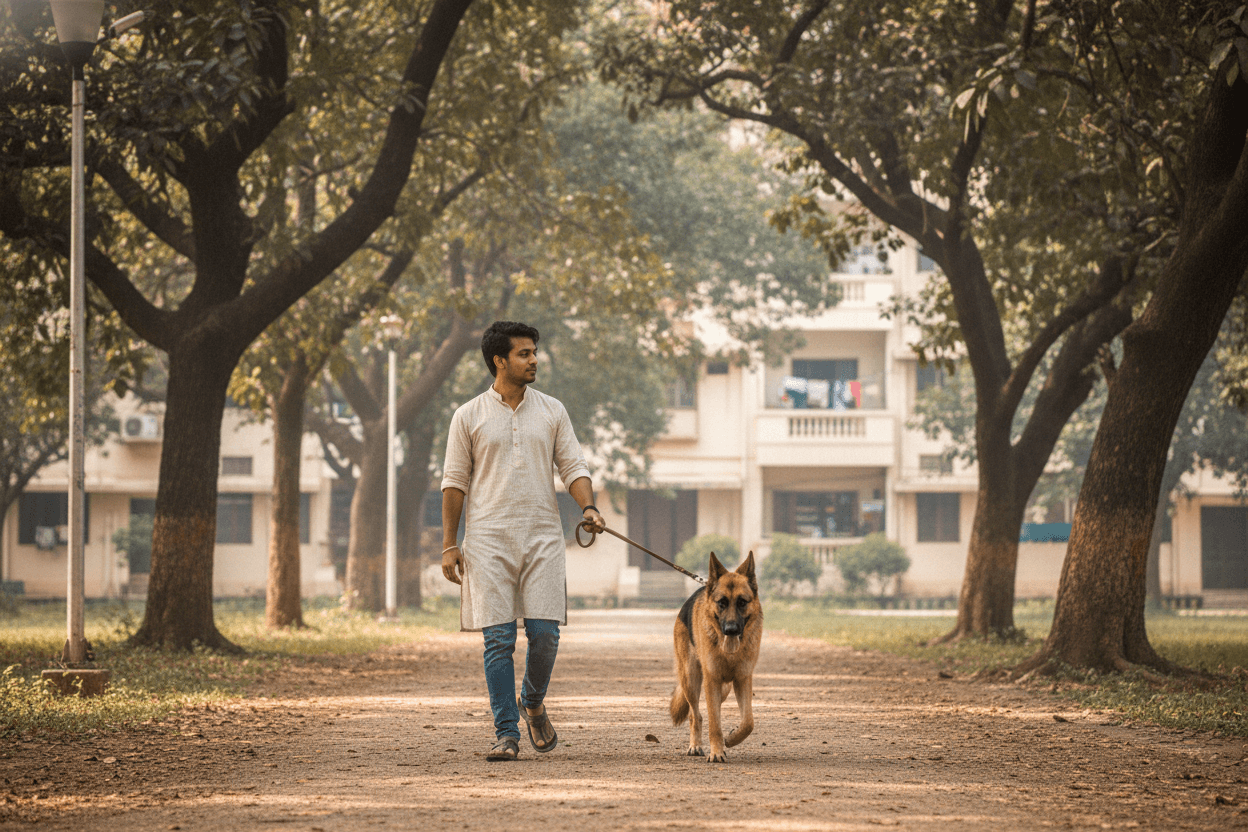
German Shepherd is India's definitive working dog. The Indian Army, CRPF, BSF, and state police forces use GSD exclusively for detection, patrol, and search-and-rescue, consuming approximately 2,000 GSDs annually from specialized military breeding farms in the Meerut and Bareilly belt near Delhi. For civilian households, GSD and Rottweiler together account for 68% of guard-breed purchases in Indian urban homes, per The Hindu's 2025 guard dog economics reporting.
KCI-registered guard dogs carry a substantial price premium: standalone house owners in metros pay ₹10,000 to ₹50,000 for verified lineage. Monthly food for a 30 to 40 kg guard breed runs ₹5,000 to ₹8,000 on premium kibble, or ₹3,000 to ₹5,000 on a home-cooked rice-and-chicken diet. The economics of guard dog ownership escalate sharply when genetic conditions appear.
Degenerative myelopathy affects 15 to 20% of Indian German Shepherds due to widespread inbreeding in unregistered programs. Onset arrives at 7 to 9 years with no cure, resulting in hindquarter paralysis. Dilated cardiomyopathy (DCM) prevalence in Indian GSDs runs 12 to 15%, with cardiac workup costing ₹8,000 to ₹18,000 at specialty centers in Mumbai, Delhi, and Bangalore.
Rottweiler ownership carries a legal complication: the breed is banned or restricted in at least 14 Indian municipal jurisdictions as of 2025, with fines of ₹5,000 to ₹25,000 and mandatory muzzle laws varying by state. Doberman Pinscher prices span ₹15,000 to ₹35,000 unregistered and ₹40,000 to ₹80,000 for KCI-registered European bloodlines; professional obedience training costing ₹8,000 to ₹20,000 in major cities is widely considered non-optional for households with children.
For more on foreign breeds — 12-point comparison, see our foreign breeds — 12-point comparison guide.
The Designer and Exotic Breed Trap: Huskies, Doodles, and Unregulated Hybrids in India
Siberian Husky represents the clearest mismatch between marketing and biology in the Indian pet market. Sold for ₹40,000 to ₹80,000 in cities like Chennai and Hyderabad, where summer temperatures routinely hit 40 to 45 degrees Celsius, Huskies are a cold-climate working breed designed for Arctic conditions. Husky owners in non-AC Indian homes report 3 to 5 times higher veterinary bills than Labrador owners, primarily from heat stroke emergencies, skin infections, and stress-induced behavioral disorders, according to the PAWS India Designer Breed Welfare Report 2025.
The doodle category operates on a different kind of deception. Goldendoodles and Labradoodles sell for ₹80,000 to ₹1,50,000 in India despite zero KCI recognition. No health testing standards apply, and F1, F2, and F3 generation claims are entirely unverifiable since no certification body oversees hybrid breeding anywhere in India. Buyers pay a premium price for dogs with less predictable temperament and health profiles than either purebred parent breed.
Alaskan Malamutes and Samoyeds, bred for negative 40 degree Arctic conditions, appear regularly in Mumbai and Bangalore pet shops at ₹50,000 to ₹1,00,000. Indian vets report near-universal behavioral and health breakdown within 18 months for these Arctic breeds placed in Indian plains conditions. Bernese Mountain Dog and Saint Bernard purchases have increased 40% since 2022 driven by social media trends, yet their average lifespan in Indian plains conditions drops to 5 to 7 years versus 8 to 10 years in native Alpine climates.
India has no breed-specific legislation at the national level as of 2026. Municipal-level breed bans in Delhi, Mumbai, and Bangalore are inconsistently enforced, creating a legal patchwork that does nothing meaningful to prevent welfare-damaging sales.
Giant Breeds in India: Great Dane, Saint Bernard, and the True Cost of XXL Dogs
Great Dane is India's most common giant breed, attracting buyers with its ₹10,000 to ₹30,000 purchase price. That price point is structurally misleading. The 10-year total ownership cost for a Great Dane in India exceeds ₹15 to ₹18 lakh when food (₹10,000 to ₹18,000 per month), veterinary care, and boarding are fully counted.
Gastric Dilatation-Volvulus (GDV or bloat) affects Great Danes at 40 to 60 times the rate of average breeds. Emergency surgery costs ₹40,000 to ₹1,20,000 at Indian metro hospitals, with 30 to 50% mortality even with treatment. The Great Dane's average lifespan is 7 to 9 years globally, often compressed to 6 to 7 years in Indian plains conditions, meaning cost per year of ownership is significantly higher than even large breeds with 10 to 13 year lifespans.
Boarding compounds the financial burden considerably. Kennel costs for giant breeds in metro cities run ₹1,500 to ₹3,500 per day versus ₹500 to ₹1,200 for medium breeds. Traveling families with a Great Dane face a hidden annual cost that rarely surfaces during the purchase conversation.
Veterinary consensus holds that Saint Bernard and Newfoundland are medically contraindicated for Indian coastal cities year-round. Irish Wolfhound and Scottish Deerhound are sold by a handful of specialty breeders for ₹80,000 to ₹1,50,000 and are suitable only in high-altitude Indian towns below 25 degrees Celsius year-round, such as Shillong, Ooty, and Manali.
10-Year Dog Ownership Cost Matrix by Breed Category in India (2026) — Example Breeds, 10-Year Total Cost
| Breed Category | Example Breeds | 10-Year Total Cost |
|---|---|---|
| INDog / Pariah Dog | Indian Pariah Dog | ₹1.5 - 2.5 lakh |
| Small Breeds | Pomeranian, Shih Tzu, Chihuahua | ₹3.5 - 5.5 lakh |
| Medium Breeds | Labrador, Beagle, Cocker Spaniel | ₹6 - 9 lakh |
| Large Breeds | GSD, Golden Retriever, Rottweiler | ₹9 - 13 lakh |
| Giant Breeds | Great Dane, Saint Bernard | ₹14 - 20 lakh |
10-Year Dog Ownership Cost Matrix by Breed Category in India (2026) — Monthly Food Cost, Key Health Risk in India
| Breed Category | Monthly Food Cost | Key Health Risk in India |
|---|---|---|
| INDog / Pariah Dog | ₹1,500 - 3,000 | Near-zero genetic disease burden |
| Small Breeds | ₹2,000 - 3,500 | BOAS, dental disease, IVDD |
| Medium Breeds | ₹4,000 - 6,000 | Obesity, hip dysplasia, ear infections |
| Large Breeds | ₹5,000 - 8,000 | DCM, cancer (60% in Goldens), myelopathy |
| Giant Breeds | ₹10,000 - 18,000 | GDV bloat, cardiac disease, joint collapse |
10-Year Dog Ownership Cost Matrix by Breed Category in India (2026) — Typical Lifespan (India)
| Breed Category | Typical Lifespan (India) | |
|---|---|---|
| INDog / Pariah Dog | 13 - 15 years | |
| Small Breeds | 12 - 16 years | |
| Medium Breeds | 10 - 14 years | |
| Large Breeds | 9 - 13 years | |
| Giant Breeds | 6 - 9 years |
Breed Noise, Aggression, and Apartment Society Rules in Indian Cities
Apartment suitability involves more than square footage. Beagle has been classified as a frequent vocalizer by veterinary behaviorists; howling from the breed triggered Resident Welfare Association (RWA) complaints and eviction notices in at least 12 documented Mumbai and Pune apartment cases. German Shepherd and Alaskan Malamute rank highest for complaint-generating vocalizations among commonly kept Indian apartment breeds.
For lower-noise living, Basenji (functionally barkless), Shih Tzu, Whippet, Cavalier King Charles Spaniel, and Labrador (a moderate barker) are considered the most apartment-compatible choices in Indian urban housing. Cocker Spaniel owners face a seasonal complication unique to India: ear infections spike 3 times during the June to September monsoon due to trapped humidity in floppy ear canals. Preventive weekly ear cleaning reduces the infection rate by 60% according to Indian veterinary data.
On the legal front, the Animal Welfare Board of India (AWBI) guideline from 2015, reiterated in 2023, explicitly states no housing society can ban pets or specific breeds. Enforcement requires the owner to issue a legal notice, which functions as a practical deterrent for most residents. Many metro apartment complexes in Delhi, Mumbai, and Bangalore continue to maintain informal banned breed lists covering Rottweiler, Pit Bull, and Doberman, with owners reporting denial of elevator access and security gate harassment despite the AWBI position.
Dalmatian buyers face a separate, under-discussed risk. Deafness screening is absent across Indian Dalmatian breeding programs, and approximately 30% of Indian-bred Dalmatians are unilaterally or bilaterally deaf, a condition typically discovered only after the puppy has been brought home.
KCI Registration, Ethical Breeders, and Avoiding Pet Shop Fraud in India 2026
The Kennel Club of India (KCI) issues pedigree certificates only for dogs registered from KCI-registered parents. These certificates are the sole verifiable breed documentation in India. All other pedigree papers sold in Indian pet shops and by backyard breeders are self-printed forgeries. KCI-registered puppies cost 2 to 4 times their unregistered counterparts, a premium justified by health-tested parents, genetic lineage verification, and materially reduced lifetime disease burden.
Pet shop sourcing is the primary driver of puppy mill demand in India. Puppies separated before 8 weeks, standard practice in most Indian shops, show 3 times higher aggression and 4 times higher anxiety disorders as adults, per PAWS India's 2025 welfare report. Online platforms including OLX and QuikrPets remain the primary channels for unethical breed sales. AWBI has repeatedly called for mandatory breeder licensing, but no national legislation had passed as of early 2026.
Teacup fraud warrants specific attention. Teacup Pomeranian and Teacup Chihuahua are sold across Indian cities for ₹25,000 to ₹60,000. No such breed standard exists anywhere in the world. These are runts with severe organ compression, hypoglycemia risk, and compressed lifespans of 6 to 9 years.
Adoption from municipal shelters offers the most cost-effective and welfare-positive path available to Indian dog owners. INDog adoption costs ₹500 to ₹2,000 versus ₹8,000 to ₹1,50,000 for purebreds. NGOs including Friendicoes in Delhi, CUPA in Bangalore, and SPCA Chennai collectively process 500 to 1,500 adoptions monthly, placing vaccinated, sterilized dogs with documented health histories. For most Indian households, the INDog's 10-year cost of ₹1.5 to ₹2.5 lakh, zero genetic disease burden, and full climate adaptation represent a combination no imported breed category can replicate.
For more on small breeds homes, see our small breeds homes guide.
KCI Verification: One Check That Eliminates Most Pedigree Fraud
Ask any breeder for the dam's (mother's) KCI registration number before visiting the litter. Cross-check that number directly on the KCI website or by calling the KCI Mumbai office. A genuine KCI pedigree cannot be issued without the mother being registered. If the breeder cannot provide the mother's KCI number, no authentic documentation exists for the litter regardless of what papers they offer at the time of sale. For more on pariah live apartments? flat, see our pariah live apartments? flat guide.
Frequently Asked Questions
What is the most popular dog breed in India in 2026?
Labrador Retriever has topped KCI registration charts for 12 consecutive years and remains India's most popular purebred in 2026. India has approximately 32 million pet dogs total, with the Labrador leading due to its heat tolerance, trainability, and compatibility with Indian joint family households. German Shepherd holds second place and is the exclusive working breed for the Indian Army, CRPF, and BSF, with approximately 2,000 GSDs consumed annually by military breeding programs alone. Golden Retriever holds third position in KCI registrations, though its 60% lifetime cancer risk and associated treatment costs of ₹80,000 to ₹3,00,000 at Indian oncology centers represent a significant long-term financial commitment.
Are brachycephalic breeds like Pugs and French Bulldogs suitable for Indian summers?
Brachycephalic breeds carry serious and well-documented health risks in India's climate. Indian veterinarians recorded a 340% increase in BOAS surgical cases between 2019 and 2024, directly correlated with rising Pug and French Bulldog popularity. At 40 degrees Celsius, common in Delhi, Nagpur, and Hyderabad, these dogs reach critical heat stress within 15 minutes outdoors. Pug BOAS surgery costs ₹25,000 to ₹60,000 per procedure. French Bulldogs require 24/7 air conditioning in any city above 30 degrees Celsius and cost ₹80,000 to ₹1,50,000 to purchase. Pug skin fold infections are 3 times more prevalent in coastal cities like Mumbai and Chennai than in dry northern cities. Any household considering a brachycephalic breed must budget for permanent climate control infrastructure and elevated lifetime surgical costs before committing.
Can Indian apartment societies legally ban specific dog breeds from their premises?
No Indian housing society can legally prohibit dogs or restrict specific breeds from residential premises. The Animal Welfare Board of India (AWBI) issued this guideline in 2015 and reiterated it explicitly in 2023. The directive covers all Resident Welfare Associations and cooperative housing societies across India. Enforcement, however, remains the dog owner's individual responsibility: challenging a ban requires serving a formal legal notice on the society, which most residents find prohibitively difficult in practice. Many metro apartment complexes continue to maintain informal banned breed lists covering Rottweiler, Pit Bull, and Doberman, creating real-world barriers including denial of elevator access and repeated gate harassment, despite these restrictions having no legal validity under AWBI guidelines.
How much does it cost to own a dog in India over 10 years by breed size?
Dog ownership costs in India vary dramatically by breed size and health profile, and most buyers significantly underestimate the full number. An INDog adopted from a municipal shelter costs ₹1.5 to ₹2.5 lakh over 10 years with near-zero genetic disease burden. Small breeds like Pomeranian and Shih Tzu cost ₹3.5 to ₹5.5 lakh. Medium breeds like Labrador and Beagle run ₹6 to ₹9 lakh, with Labrador trending toward the upper range due to obesity-related diabetes and joint surgeries averaging ₹30,000 to ₹80,000. Large breeds including German Shepherd and Golden Retriever cost ₹9 to ₹13 lakh, with Golden Retriever cancer treatment alone reaching ₹80,000 to ₹3,00,000 at Indian oncology centers. Giant breeds like Great Dane reach ₹14 to ₹20 lakh total, with food alone representing ₹10 to ₹15 lakh across the ownership period. Pet insurance covers under 2% of dogs in India, meaning all these costs are paid entirely out of pocket.