Key Takeaways
- The puppy socialization window is 3 to 16 weeks; missing it significantly increases lifetime risk of fear disorders and aggression
- Bring your puppy home on a weekday morning and avoid festival weeks like Diwali and Holi entirely
- Train before 9am or after 6pm in Indian summers; pavement above 40 degrees Celsius causes paw pad burns in under 30 seconds
- Wire crates (INR 2,500 to 6,000) from Trixie or Savic are preferred over plastic airline crates in hot Indian cities for ventilation
- Rabies vaccination at 12 weeks is mandatory under the Prevention and Control of Infectious and Contagious Diseases in Animals Act, 2009
- INDog puppies from shelters cost INR 0 to 2,000 including initial vaccination versus INR 15,000 to 80,000 for KCI-registered foreign breed puppies from breeders
- Professional trainers in India charge INR 3,000 to 8,000 per month for group classes and INR 8,000 to 25,000 for private in-home sessions
First Week Home With a New Puppy in India
Time your puppy's arrival carefully. Bring the puppy home on a weekday morning so the family has a full day to help the puppy settle before the first night. Avoid bringing any puppy home during Diwali, Holi, or any major festival week. The noise, fireworks, and irregular household schedules during these periods can cause lasting trauma in a puppy still learning that the world is safe.
Heat is the first physical risk for any puppy arriving in India. Summer temperatures regularly exceed 40 degrees Celsius in cities like Delhi, Nagpur, and Ahmedabad, making heat stroke a genuine first-week danger. Set up the puppy's crate or playpen in a cool, shaded area away from direct sunlight and away from the kitchen, which is consistently the hottest room in most Indian homes. A wire crate positioned near a fan solves both the ventilation and safety problems at once.
Do not bathe the puppy for the first seven days. Allow them to acclimatise to the smells and sounds of the home first. Indian households often include multiple family members, domestic helpers, and frequent visitors. Introduce each person one at a time to avoid overwhelming a puppy already processing a completely new environment.
Puppies sleep 18 to 20 hours per day in the first weeks. In joint-family households, this requires active management of who has access to the puppy and when. Designating structured quiet rest periods each day prevents the common mistake of passing the puppy from person to person until it collapses from exhaustion. Indian pet ownership grew 35 percent between 2020 and 2024, with first-time owners now accounting for over 60 percent of new puppy purchases. Most first-week problems stem from too much stimulation rather than too little attention.
For the first three nights, place a warm water bottle wrapped in cloth near the puppy's sleeping area. This simulates the warmth of litter mates and significantly reduces night crying without creating dependence on human presence.
You might also find our obedience training — expert commands, guide helpful.
Basic Obedience Commands for Indian Puppies
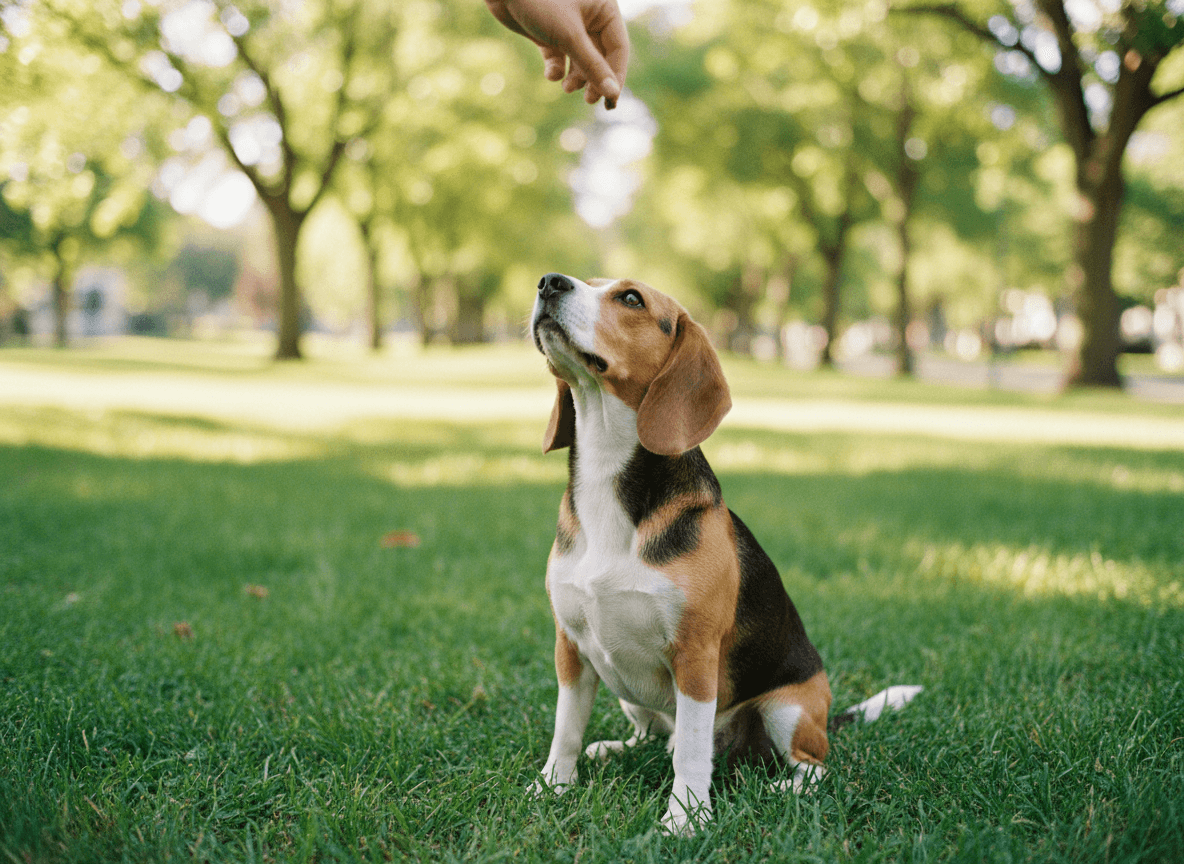
Training can and should begin the day your puppy comes home at 8 weeks. According to the American Kennel Club, the four foundational commands (Sit, Stay, Come, and Down) can all be introduced from 8 weeks using sessions of 3 to 5 minutes held twice daily. Puppy attention spans cap at roughly 5 minutes, making short and frequent sessions far more effective than extended ones.
The language you use does not matter as long as it is consistent. Many Indian trainers use Hindi alongside English, and either works equally well. Using 'Baitho' for sit or 'Aa Jao' for come is completely valid. One word per behavior, used consistently by every household member, is the only rule that matters.
Teaching Stay is especially critical in Indian households where front doors open directly onto busy roads or shared building corridors. Begin with a 2-second stay and build gradually to 30 seconds before adding any distance between you and the puppy. A reliable stay can prevent a puppy from bolting into traffic, which in Indian cities is a genuinely life-threatening scenario in seconds.
Recall (Come or Aa Jao) is the single most important safety command given India's stray dog density and open traffic in residential areas. Practice recall only in a safe, enclosed space before attempting it outdoors. Never punish a puppy who comes to you, even if they took too long or required multiple calls. Punishment breaks the recall association and can take weeks to repair.
Schedule all training sessions before 9am or after 6pm. A puppy cannot learn effectively when thermally stressed, and Indian midday heat regularly pushes ground temperatures to levels that cause discomfort before visible behavioral changes appear. Lure-reward training, guiding the puppy into position using a treat, is the most effective approach under 12 weeks. Fade the food lure by 12 to 14 weeks and shift to a hand signal so the behavior becomes cue-based rather than food-dependent.
For more on aggression training india — methods,, see our aggression training india — methods, guide.
For more on pug french bulldog 2026, see our pug french bulldog 2026 guide.
Crate Training for Indian Apartments
Most Indian urban apartments range from 400 to 1,200 square feet (1BHK to 3BHK). A crate in these spaces serves as a safe den that prevents destructive behavior when the family is out or asleep. The crate should be large enough for the puppy to stand, turn around, and lie flat, but not so large that one end becomes a designated toilet area.
Wire crates are preferred over plastic airline-style crates in India because of ventilation. In cities like Chennai, Hyderabad, and Mumbai during April to June, air circulation inside a crate can be the difference between a comfortable puppy and a heat-distressed one. Trixie and Savic wire crates suitable for medium breeds such as Labrador Retriever, Golden Retriever, and German Shepherd cost INR 2,500 to 6,000 and are available at Heads Up For Tails stores across Delhi, Mumbai, Bengaluru, Pune, and Hyderabad, as well as at Petsworld online.
Introduce the crate gradually. Feed all meals inside the crate for the first 3 to 5 days before closing the door at all. Once the puppy eats comfortably inside, close the door for 30 seconds. Extend that duration slowly over days, never progressing faster than the puppy's comfort allows. Never use the crate as punishment; doing so permanently associates it with negative experiences.
Many Indian families resist crate training, believing it to be cruel. Framing the crate as the puppy's personal room rather than a cage helps significantly with family buy-in. Without crate training, dogs confined to small apartments frequently develop separation anxiety and destructive chewing patterns that are far harder to fix than they are to prevent from the start.
Puppies under 10 weeks cannot hold their bladder for more than 2 hours. In apartments without direct garden or courtyard access, set up a designated elimination spot using pee pads or a grass patch on the balcony. This interim toilet area bridges the gap until the puppy completes vaccination at 16 weeks and can go outdoors safely.
For more on food india — buying brand, see our food india — buying brand guide.
Learn more in our detailed apartments — breeds ranked size, resource.
Puppy Training and Vaccination Options in India: Cost and Format Guide (2025 to 2026) — Format, Cost (INR)
| Option | Format | Cost (INR) |
|---|---|---|
| Group Puppy Classes | 4 to 8 sessions per month at a training facility | 3,000 to 8,000 per month |
| Private In-Home Training | Weekly visits from a certified trainer | 8,000 to 25,000 per month |
| Board-and-Train (Residential) | Puppy stays with trainer full-time | 15,000 to 60,000 per month |
| Online Classes (e.g. Heads Up For Tails Academy) | Self-paced video modules | 500 to 3,000 per course |
| Full Vaccination Course (Private Vet) | 4 shots over 10 weeks | 2,500 to 5,000 total |
| Vaccination (Municipal Government Hospital) | Same schedule at government facility | 50 to 200 per shot |
Puppy Training and Vaccination Options in India: Cost and Format Guide (2025 to 2026) — Best For
| Option | Best For | |
|---|---|---|
| Group Puppy Classes | Basic obedience and early socialization | |
| Private In-Home Training | Behavior-specific issues and custom programs | |
| Board-and-Train (Residential) | Intensive early foundation training | |
| Online Classes (e.g. Heads Up For Tails Academy) | Basic commands for budget-conscious owners | |
| Full Vaccination Course (Private Vet) | Full parvovirus, distemper, and rabies protection | |
| Vaccination (Municipal Government Hospital) | WHO-approved vaccines at reduced cost |
Bite Inhibition in Puppies
Bite inhibition refers to a dog's learned ability to control the force of its mouth. The optimal window for teaching this is 7 to 14 weeks. Puppies begin learning from litter mates: when a puppy bites too hard, the bitten pup yelps and stops playing, teaching the biter that hard biting ends the fun. Puppies removed from litters before 7 weeks miss this foundational lesson and need owners to substitute for it.
The most effective owner-delivered technique is the yelp-and-withdraw method. When the puppy bites skin, make a sharp 'ouch' sound in a high-pitched tone and immediately stop all interaction for 30 to 60 seconds. Withdraw your hand, turn away, and ignore the puppy completely. Resume play after the pause. Consistency across every household member is essential; a single person who lets biting continue without consequence undermines the entire process.
Dogs that do not learn proper bite inhibition as puppies account for approximately 70 to 80 percent of serious bite injuries. This makes bite inhibition training especially non-negotiable in Indian joint-family homes where children and elderly family members are regularly present and often engage with the puppy in unpredictable or rough ways.
Punishing puppy mouthing by hitting, scruff shaking, or alpha-rolling is still circulated as advice in India, particularly by older-generation owners and some unqualified trainers. These methods suppress warning signals rather than teaching control, producing dogs that bite without growling first. That outcome is the most dangerous possible result of misguided training.
Redirect mouthing onto appropriate chew items. Natural alternatives widely available at Indian pet stores include bully sticks, dried buffalo ears, and rawhide chews. Heads Up For Tails and Amazon India stock these for INR 80 to 400 per piece. The bite inhibition window closes around 18 weeks; any puppy still biting hard at 16 weeks needs professional trainer intervention without delay.
You might also find our labrador golden retriever — comparison guide helpful.
India-Specific Challenges: Heat, Monsoon, Strays, Festivals, Firecrackers
Heat is the most underestimated puppy risk in India. Inland cities including Nagpur, Delhi, and Ahmedabad regularly reach 42 to 48 degrees Celsius between March and June. All outdoor training must happen before 8am or after 7pm in summer. Pavement temperatures can exceed 60 degrees Celsius and cause paw pad burns in under 30 seconds. If the pavement feels too hot for the back of your hand after 5 seconds, it is already damaging for your puppy's paws.
The Indian monsoon (June to September) introduces a different category of hazards. Waterlogged streets carry leptospirosis, parvovirus, and hookworm. These diseases can be fatal to unvaccinated puppies and dangerous even to partially vaccinated ones. Wipe all four paws with a dilute antiseptic solution after every outdoor excursion during monsoon season, and avoid areas of visible standing water entirely.
Diwali firecracker noise phobia affects an estimated 45 to 60 percent of pet dogs in India based on veterinary clinic reports. Begin desensitization 6 to 8 weeks before Diwali using recorded firecracker sounds played at the lowest possible volume, increasing gradually over weeks while pairing sound with high-value food rewards. Dogs with established phobia may need veterinary anti-anxiety medication during the peak Diwali period.
Festival management extends beyond Diwali. Keep puppies indoors during Holi color play as gulal is toxic if ingested or inhaled. Noise and crowds during religious processions can overwhelm young puppies and create fear associations that persist into adulthood, affecting every future walk near religious or community events.
Teach the 'leave it' command from week 10 specifically for Indian street conditions. Cow dung, garbage, stagnant water, and discarded food are common on Indian roads. A reliable 'leave it' prevents ingestion of pathogens on every single walk, making it as important a safety command as recall in the Indian urban context.
Do Not Wait for Full Vaccination to Begin Socialization
A common mistake in India is waiting until the 16-week final booster before starting any socialization. By that point, 60 percent of the critical socialization window has already closed. The American Veterinary Society of Animal Behavior states the behavioral risk of missed socialization outweighs the disease risk of early, controlled exposure. Carry your puppy in arms to busy areas from 10 weeks onward, and enroll in puppy classes after the second vaccination at 8 to 10 weeks, provided all attending puppies are vaccinated to the same level and the venue is regularly cleaned. For more on crate free roaming away, see our crate free roaming away guide.
Vaccination Timing and How It Affects Training in India
The standard Indian puppy vaccination schedule runs as follows: 6 weeks (Parvovirus and Distemper starter dose); 8 weeks (7-in-1 DHPPiL combo vaccine); 12 weeks (7-in-1 booster and Anti-Rabies); 16 weeks (final 7-in-1 booster and Anti-Rabies booster). Full outdoor protection is considered complete at 16 to 18 weeks.
The 7-in-1 (DHPPiL) vaccine covers Distemper, Hepatitis, Parvovirus, Parainfluenza, and Leptospirosis. Leptospirosis coverage is especially valuable in India given annual monsoon flooding in most urban areas. A full vaccination course from a private vet costs INR 2,500 to 5,000 depending on city and clinic. Government veterinary hospitals under municipal corporations in Delhi, Mumbai, Bengaluru, and Chennai offer the same WHO-approved vaccine formulations for INR 50 to 200 per shot.
Rabies vaccination at 12 weeks is mandatory under the Prevention and Control of Infectious and Contagious Diseases in Animals Act, 2009. Rabies vaccination certificates are required for interstate travel with any pet in India, so maintain all records from the first shot onward.
Puppy classes can safely begin after the second vaccination at 8 to 10 weeks, provided the training venue is regularly cleaned and all attending puppies are vaccinated to the same level. Waiting until 16 weeks to begin group socialization misses the most formative developmental period and consistently produces more reactive, harder-to-integrate adult dogs.
Parvovirus is endemic in Mumbai and Delhi in particular. Behavioral specialists consistently confirm that the long-term behavioral damage from missing the socialization window is both more common and significantly harder to treat than a successfully vaccinated puppy contracting parvovirus through uncontrolled exposure. Controlled socialization starting at 8 to 10 weeks is the correct evidence-based recommendation.
Indian Breed Considerations: INDog, Rajapalayam, Mudhol Hound vs Foreign Breeds
The INDog (Indian Pariah Dog) is one of the world's oldest landrace breeds, with genetic lineage tracing back over 4,000 years. Highly adapted to Indian heat, disease-resistant, and cooperative by nature, INDogs are typically easier to train than many foreign breeds. Adopting an INDog puppy from shelters including CUPA Bengaluru, Friendicoes Delhi, RESQ Pune, or Charlie's Animal Rescue Centre in Mumbai costs INR 0 to 2,000 and usually includes initial vaccination. Compare this with INR 15,000 to 80,000 for a KCI-registered foreign breed puppy from a breeder.
Indigenous sighthounds including the Rajapalayam, Mudhol Hound, Chippiparai, and Kanni are all recognized by the Kennel Club of India. These breeds are highly intelligent but independent and sensitive in nature. They respond poorly to harsh training methods and deliver dramatically better results with force-free positive reinforcement. Rushing or pressuring a Rajapalayam puppy often produces shutdown behavior rather than compliance. The Mudhol Hound was inducted into the Indian Army's canine unit in 2017, the first indigenous breed selected for military service, which confirms the trainability of Indian breeds when handled correctly.
Foreign breeds most popular in Indian cities based on KCI 2024 registrations include Labrador Retriever, Golden Retriever, German Shepherd, Beagle, and Pug. These breeds were developed for cold European climates and require careful heat management in India. Outdoor training for Labradors and Golden Retrievers must strictly avoid midday hours and should never occur when pavement temperatures are extreme.
Brachycephalic breeds including Pug, French Bulldog, Shih Tzu, and Lhasa Apso are increasingly common in Indian metro apartments. These breeds are especially vulnerable to overheating and should not be exercised outdoors above 28 degrees Celsius. All training sessions during the summer months must take place in air-conditioned indoor environments for these breeds without exception.
Positive Reinforcement with Indian Food Treats
The best training treats for Indian puppies are usually already in your kitchen. Small pieces of boiled chicken breast (no spices, no salt), paneer, boiled egg white, and small pieces of banana are all highly effective rewards that cost far less than commercial alternatives. Plain boiled chicken cut into pea-sized pieces is the gold standard for high-motivation training sessions and works across virtually all breeds and temperaments.
Common foods given to puppies in Indian households that must be avoided include roti with butter or ghee, Parle-G biscuits, spiced meat, and milk. These cause digestive upset and, in the case of fatty foods, can trigger pancreatitis in young puppies. Domestic helpers and extended family members are often the source of these treats, so alignment across the entire household is necessary.
Seasonal Indian fruits that are safe in small amounts include jackfruit (kathal), mango, and watermelon. Foods that are toxic to dogs and frequently present in Indian kitchens include grapes, raisins, onion, garlic, and all spiced snacks. Posting a list on the refrigerator and briefing domestic helpers reduces accidental poisoning risk significantly.
For timing precision, use a clicker. Clickers available at Heads Up For Tails and PetZone cost INR 100 to 200. The treat must reach the puppy within 1 to 2 seconds of the correct behavior. The clicker marks the exact moment of success, making the connection between behavior and reward far clearer for a puppy whose attention window is measured in seconds.
Commercial training treats available across India include Drools Absolute Bites, Dogaholic Milky Sticks, and Pedigree treats, ranging from INR 80 to 350 for 100 to 200 gram packs at Heads Up For Tails, PetZone, Amazon India, and Flipkart. Treats should account for no more than 10 percent of daily caloric intake. In joint-family homes, make sure every household member understands this limit; grandparents and children typically over-treat without realizing the cumulative caloric impact or the training devaluation that results from constant free access to food.
Finding a Professional Dog Trainer in India
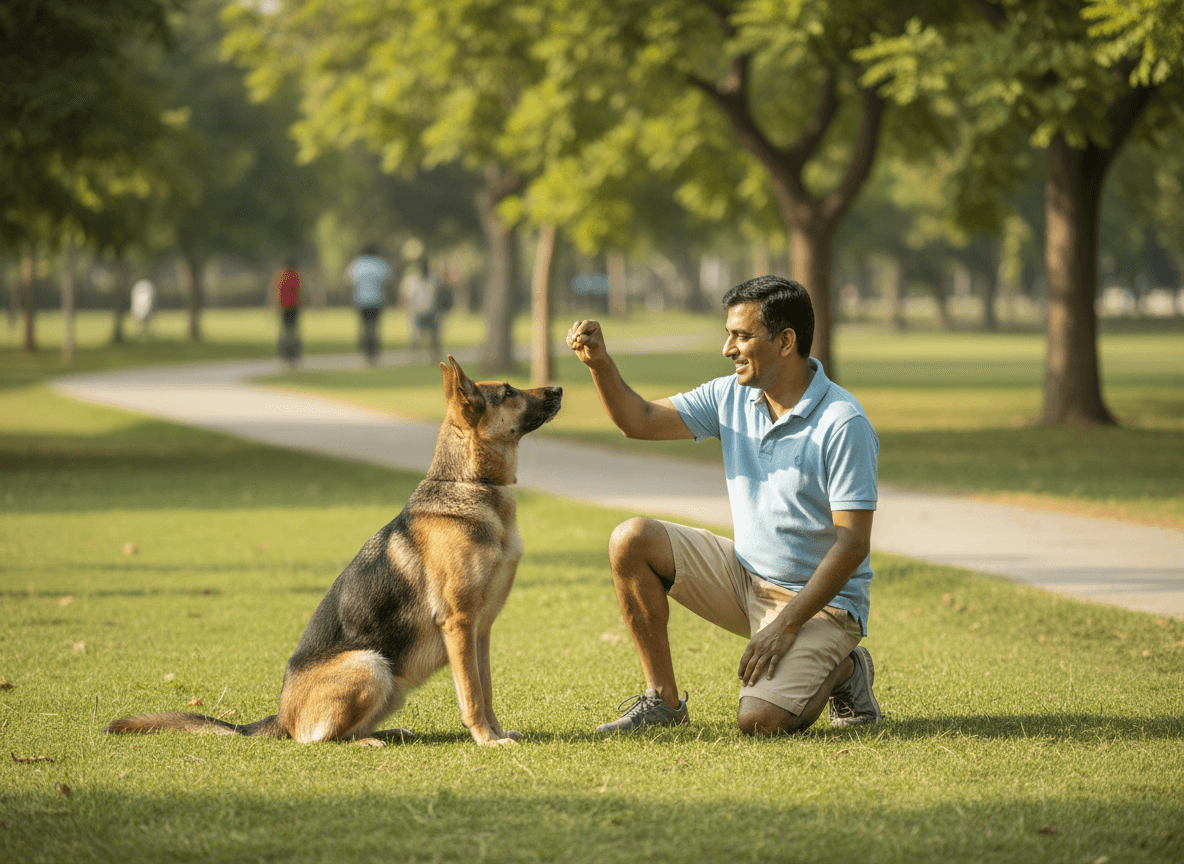
Pricing for professional dog training in India as of 2025 to 2026: group puppy classes cost INR 3,000 to 8,000 per month for 4 to 8 sessions; private in-home training runs INR 8,000 to 25,000 per month; board-and-train residential programs cost INR 15,000 to 60,000 per month.
There is no mandatory licensing or certification body for dog trainers in India, which means anyone can legally call themselves a professional trainer. The certifications to look for are the Association of Pet Dog Trainers (APDT), Karen Pryor Academy Certified Training Partner (KPA-CTP), and the International Association of Animal Behavior Consultants (IAABC). These international certifications confirm force-free, science-based methodology rather than outdated dominance approaches.
Certified professional trainers are most concentrated in Bengaluru, Mumbai, Delhi/NCR, Pune, and Hyderabad. Tier-2 cities including Ahmedabad, Jaipur, Kochi, and Chandigarh have smaller but growing trainer ecosystems. Notable India-based training establishments include Canines Can in Mumbai, Dog Squad in Delhi/NCR, The Dogue in Bengaluru, K9 Kulture operating across Mumbai and Pune, and Paws and Claws Academy in Hyderabad. Always verify the trainer's methods before committing.
Red flags when evaluating any trainer in India: use of choke chains, prong collars, or shock collars; claims to practice 'dominance theory' or 'alpha methods'; promises of complete behavioral change in a single session; refusal to explain training methods in advance; and trainers who will not allow owners to observe sessions. Any trainer who insists owners must not watch is protecting their methods from scrutiny for a reason.
Online puppy training has grown substantially in India since 2020. Platforms including Heads Up For Tails Academy and YouTube channels run by certified Indian trainers offer free and paid content. Online training is effective for basic obedience but insufficient for socialization and reactivity work, which require controlled real-world environments and direct trainer observation.