Key Takeaways
- Puppies gain full bladder control between 4–6 months; night-time control develops 2–4 weeks after daytime control
- Apartment training in India requires earlier signal-reading — you have 3–4 minutes, not 10, before an accident
- Monsoon months (June–September) cause a spike in indoor accidents; covered balcony zones and ₹300–600 raincoats solve most of it
- Indian Pariah dogs and desi breeds often house-train 3–4 weeks faster than imported breeds due to natural cleanliness instincts
- Any sudden regression after good progress warrants a vet visit — UTIs and giardia account for 15–20% of house training setbacks
Why House Training in India Is Different
House training a puppy in a Mumbai high-rise is nothing like doing it in a bungalow with a garden in Coimbatore. You're dealing with elevators that are slow, monsoons that last four months, tile floors that hold urine scent differently than carpet, and a joint family where six people may have six different responses to accidents. Our house training guide covers this in detail.
I got my first puppy, a desi breed named Kuttie, in a Bengaluru apartment on the 11th floor. The lift took two minutes. Kuttie, at 9 weeks, could hold it for approximately 2 hours. You do the math — there was zero margin for error once the signals started.
Later, with a Labrador named Bruno in Chennai, the summer heat meant he was drinking 30–40% more water than usual, which meant bathroom trips every 90 minutes at peak heat. No guide I found acknowledged any of this. This one does.

Bladder Development: What the Timeline Actually Looks Like
Puppies can't hold their bladder voluntarily until around 16 weeks, and even then it's partial. The widely cited rule of thumb — one hour of hold time per month of age — holds up reasonably well. An 8-week puppy: 2 hours max. A 12-week puppy: about 3 hours. At 16 weeks, expect 4 hours. According to the American Kennel Club, most puppies achieve reliable daytime control between 4–6 months, with night-time control typically lagging 2–4 weeks behind.
Bruno, my Labrador, was 3 months when we brought him home to Chennai. During June heat (regularly 38–40°C), he was drinking so much water that his actual hold time was closer to 90 minutes, not the textbook 3 hours. Indian summer heat is a real variable that most guides skip entirely.
What I didn't expect: night-time control came almost a full month after he was solid during the day. So don't assume daytime success means you can stop the late-night trips. It doesn't work that way.
Puppy Bladder Control by Age
| 8 weeks | 1–2 hours | 10–12 trips/day |
| 12 weeks | ~3 hours | 8–10 trips/day |
| 16 weeks | ~4 hours | 6–8 trips/day |
| 6 months | 5–6 hours | 4–6 trips/day |
| 8 months+ | 7–8 hours | Fully trained |
Note: These are averages. Heat, water intake, and individual variation all shift these numbers. Track your specific puppy for the first 4 weeks before assuming the standard timeline applies.
Apartment Training: High-Rise Realities in Indian Cities
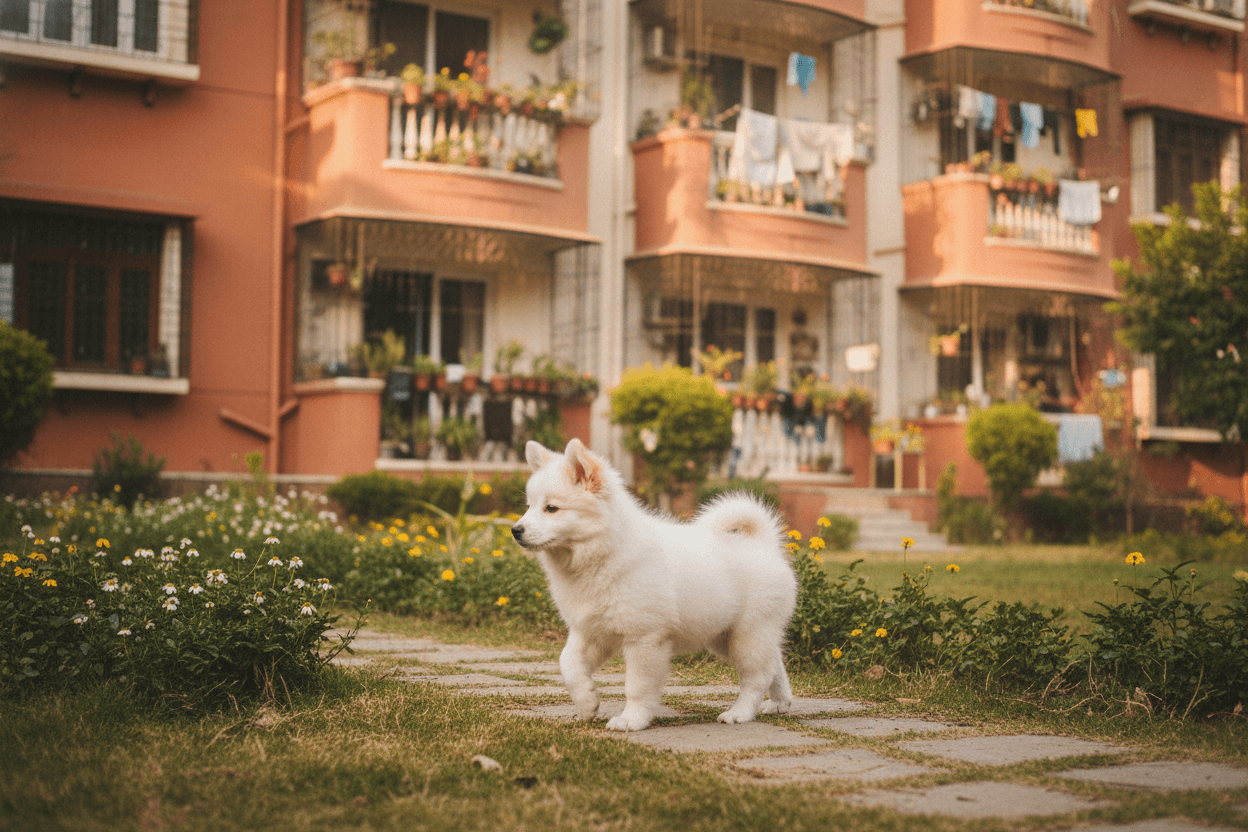
Most Indian metro dog owners live in apartments. The elevator problem is real and underestimated. Kuttie on the 11th floor — when she started sniffing intensely and circling, I had 3–4 minutes, not 10. I had to read her signals earlier than I would have needed to from a ground-floor house. For high-rise apartment protocols covering elevator and crate schedules, see the apartment house training guide.
The signals to watch for: intense ground sniffing that's different from casual sniffing, circling in the same small area, whining, moving suddenly toward the door, and stopping mid-play to squat. Get those signals down in the first week and you'll cut accidents by 60%.
Balcony training saved us. I set up one corner of the balcony with a coconut coir mat, which costs about ₹150–200 from any hardware store in Bengaluru (I've seen the same ones at SPAR and local nilgiris-area stores for the same price). The scent builds up on the mat and your puppy learns that corner is their bathroom zone. Coir works better than newspaper because it doesn't slide, doesn't disintegrate in Mumbai humidity, and absorbs decently well.
Build rapport with your building security staff early. I introduced Kuttie to our security uncle on day two, explained we'd be coming down frequently, and gave him a small bag of treats to offer her when we passed. Within a week she was calm in the elevator and actually comfortable with the routine. Those small relationship investments pay off for months.
- Set up a balcony training zone: coconut coir mat (₹150–200) or newspaper layers with a plastic tray underneath
- Keep an emergency indoor backup near the front door during the first 8–12 weeks — plastic sheet + newspaper layer, easy to swap out
- Introduce your puppy to building security staff in week one; get their buy-in for frequent elevator trips
- Install a small bell on your door handle and teach bell-ringing as a signal — works surprisingly well in apartments where you can't see the puppy from the main rooms
- Have cleaning supplies staged at the entrance: spray bottle with 1:1 white vinegar-water solution, old towels, baking soda
Training Schedules That Work for Indian Households
The non-negotiable trips: immediately after waking (within 10–15 minutes), 15–30 minutes after every meal, after every nap, and after high-energy play. These four windows account for about 80% of all elimination events in puppies under 5 months.
Indian households often have irregular mealtimes. If your puppy's meals shift by 2 hours depending on who's home, their bathroom schedule shifts too — which means you can't predict the windows. Feed at fixed times, even if it feels rigid. Three meals daily for puppies under 6 months, at the same times every day. This one change cut Bruno's accidents from 3–4 daily to 1–2 within two weeks.
The AKC recommends rewarding within 1–3 seconds of the desired behavior. That means the treat comes while your puppy is still finishing elimination, not when you're back inside. I kept treat pouches by the door specifically for this — the 3-second window closes fast.
Working families need midday coverage. Dog walker services in Bengaluru and Delhi run ₹200–600 per visit (Sploot, PawSpace, and Tailz.in all operate in major metros). For puppies under 4 months, one midday visit is worth every rupee — it fills the gap between your morning departure and evening return and prevents the accidents that result from 8–9 hour holds that a young puppy simply can't manage.
Sample Daily House Training Schedule
| 6:00–6:30 AM | Immediate bathroom trip after waking |
| 7:00–7:30 AM | Bathroom break 15–20 min after breakfast |
| 10:00–10:30 AM | Mid-morning break after play |
| 1:00–1:30 PM | Post-lunch break (or midday dog walker visit) |
| 4:00–4:30 PM | After-nap break |
| 7:30–8:00 PM | Post-dinner break |
| 10:30–11:00 PM | Last trip before bed |

Monsoon Training: June–September in Indian Cities
Bruno hated rain. During Chennai's monsoon he'd hold his bladder for 4–5 hours rather than step into a drizzle, then have an indoor accident the moment he couldn't hold it anymore. That's not disobedience — that's a dog telling you the outdoor option is unacceptable to him.
Two solutions worked. A basic puppy raincoat from Amazon India (₹350–550 for a small breed size) made the rain tolerable — he still disliked it but would at least step out. A tarp rigged over the balcony corner with rope and plastic sheet (total cost: ₹200) gave him a dry zone without requiring a full outdoor trip. During peak downpours, the balcony zone became our primary option for 2–3 weeks.
In Mumbai and Kerala, where monsoon rainfall is heavier and lasts longer, covered balcony zones are less optional and more essential. Artificial turf patches with drainage holes cost ₹800–2,000 on Amazon India and hold up far better through repeated wet/dry cycles than coir mats do.
The trap to avoid: letting your puppy reliably use an indoor zone for more than 3–4 weeks creates a habit that can take 6–8 additional weeks to break. Use it as a monsoon backup, not a permanent solution. Our food india: buying brand guide covers this in detail.

- Cover one balcony corner with tarp or thick plastic sheet before monsoon season starts (costs ₹150–300)
- A puppy raincoat (₹350–600 on Amazon India) makes light-rain trips manageable for rain-averse dogs
- Keep quick-dry towels and a dedicated doormat at the entrance for post-rain paw wipes
- Maintain your schedule through monsoon — even if the trip is short or balcony-only, the routine consistency prevents regression
- Synthetic turf with drainage (₹800–2,000) outlasts coir mats in high-rainfall cities like Mumbai, Kochi, and Mangalore
Handling Accidents: What to Do and What Not to Do
Accidents happen through 5–6 months even with good training — 1–2 per week in a well-trained puppy is normal, not a failure. The response matters more than the accident.
Never punish after the fact. The VCA Animal Hospitals and every legitimate veterinary source agrees on this: punishment after the event creates anxiety without conveying any information about what the puppy did wrong. A firm "no" while catching them mid-act is fine. Scolding them 30 seconds later, when they're already sniffing something else, does nothing except damage trust.
Clean accidents thoroughly with a 1:1 white vinegar and water solution (₹50–60 total from any kirana shop), followed by baking soda. Spray the area, let it sit for 10 minutes, then apply baking soda and let it dry before vacuuming or sweeping. Regular floor cleaners don't eliminate the urine scent markers that dogs track — only vinegar/enzyme-based solutions break down the uric acid compounds. If you use a standard phenyl or floor cleaner and skip this step, your puppy will return to the same spot.
Indian marble and granite floors are actually helpful here — they don't absorb urine the way carpet does, so cleanup is faster and odor removal is more complete. The main risk is tile grout, which does absorb. Get to it quickly.

When Accidents Are a Medical Problem, Not a Training Problem
This section is the one most guides skip, and it's the one that cost me 3 extra weeks of frustration with Kuttie.
She was doing well at 4 months — maybe 1 accident every 3–4 days. Then suddenly, 4–5 accidents daily for a week straight. I assumed she'd regressed. She hadn't. She had giardia — an intestinal parasite extremely common in Indian puppies, especially those who have contact with street water or contaminated soil. According to Cornell University's College of Veterinary Medicine, giardia causes watery, foul-smelling diarrhea with sudden onset. Once we treated it with metronidazole (₹80 for a course from any vet pharmacy), the accidents stopped within 10 days.
UTIs are the other common culprit. According to VCA Animal Hospitals, UTI symptoms include frequent urination of small amounts, straining, blood in urine, and licking the urinary opening. If your puppy had reliable control and suddenly can't hold it at all, rule out medical causes before assuming a training problem.
Red flags that warrant a vet visit: more than 3 accidents daily after a period of success, blood-tinged urine, straining, excessive drinking, or diarrhea coinciding with accidents. A basic urine culture at any vet clinic in India runs ₹400–800, and a stool exam for parasites is around ₹200–400.

Breed-Specific Timelines: What to Expect from Indian and Popular Breeds
Indian Pariah dogs (INDogs) and desi breeds are naturally clean. Multiple sources tracking indie dog behavior, including DCC Animal Hospital's pet care blog, note that INDogs develop instinctive elimination preferences quickly and typically house-train 3–4 weeks faster than most imported breeds. Kuttie was reliably going to the same balcony corner by week 3. Bruno, my Labrador, took 5 months to be truly reliable.
Labradors and Golden Retrievers are high water-drinkers in Indian heat, which means more bathroom trips at every age. Plan for 20–30% more trips than the standard timeline suggests during summer months (April–June). The flip side: they're extremely food-motivated, so treat-based rewards work fast.
Small breeds — Pomeranians, Shih Tzus, and Pugs — have faster metabolisms and smaller bladders. They legitimately need more trips than a same-age Labrador. Pom owners in Mumbai apartments often find that even at 6 months, their dogs need 6–7 trips daily rather than the 4–5 you'd see with a larger breed.

House Training Timelines by Breed Type
| Indian Pariah / Desi breeds | 3–4 months |
| Labrador / Golden Retriever | 4–5 months |
| German Shepherd / Rottweiler | 4–5 months |
| Small breeds (Pom, Shih Tzu) | 5–7 months |
| Beagle / Cocker Spaniel | 5–6 months |
Joint Family Households: Getting Everyone Aligned
This is India-specific and genuinely important. Many households here have 4–6 people with different schedules, different relationships with the dog, and different instincts about how to respond to accidents. If your mother-in-law is scolding accidents while your spouse is inconsistently rewarding outdoor success, your puppy is getting mixed signals from three different directions.
House training research consistently shows that inconsistent human responses are a primary driver of training failure — more so than the dog's intelligence or breed. The fix is simple: one piece of paper on the fridge listing the three rules. Same command word (pick one: "potty," "go outside," or whatever phrase you want), immediate reward for success, and no punishment for accidents. Everyone signs on, or you're adding weeks to your timeline.
Domestic helpers who are home during the day can become training partners or training saboteurs depending on how you bring them in. Take 10 minutes to explain the schedule and show them the treat location. Most helpers are happy to participate once they understand why it matters.
Independent Houses: Training With Garden Access
If you have a house with a garden or compound, you're starting with a significant advantage. Direct outdoor access means shorter response windows, quicker reinforcement, and fewer accidents because the dog can often signal and get outside in under a minute.
Pick a specific spot in the garden as the bathroom zone and go there every single time. Don't let your puppy wander the whole yard — the scent builds up at the designated spot and accelerates learning. Bruno, once we moved from the Chennai apartment to a ground-floor flat with a small terrace, trained to a new spot within 4 days.
Watch for snakes and insects during evening garden trips, especially in southern cities during monsoon. I keep a torch at the door and check the grass before letting my dog step in. This is not a concern most international training guides mention, but Indian gardens are a different environment.