Key Takeaways
- Start basic obedience at 8-12 weeks; adult Indies and rescue dogs learn just as well with patience
- Five commands prevent the most emergencies in Indian conditions: Sit, Stay, Come, Leave It, and Heel
- Train before 8 AM or after 6 PM during April-June; 10-minute sessions prevent heat exhaustion
- DIY training costs ₹500-2,000 setup; professional 6-8 week courses range ₹5,000-25,000 by city
- Diwali desensitization works — but you must start 6 weeks before, not two days before

Why Obedience Training Looks Different in India
My Labrador Bruno bolted through our apartment gate in Koramangala on a Tuesday morning when the sabziwala knocked. He ran straight into traffic on 80 Feet Road. We got lucky. That incident — three seconds of open gate, one untrained dog — is why I spent the next six months learning everything about obedience training. Not the American YouTube version. The version that actually works on Indian streets.
Obedience training is different from general dog training. House training, leash walking, separation anxiety — those are separate topics. Obedience training specifically teaches reliable command responses: your dog hears 'Come' and comes, even with a stray dog nearby, even during Holi, even when a food vendor is 10 feet away. That reliability is what keeps dogs alive in Indian cities.
The standard Western training guides don't account for 42°C summers, four months of monsoon confinement, joint families where three people give different commands, or the specific food motivators that work on desi palates — both human and canine. This guide covers all of it.
When to Start: Age Doesn't Matter as Much as You Think
The most common question I get from new dog owners is: is my dog too old to train? The answer is almost always no. Puppies can start basic obedience at 8 weeks — before full vaccination, even, because you're working indoors with lure-reward techniques, not taking them to dog parks.
The critical socialization window is 3-14 weeks, and commands introduced during this period tend to stick faster. That said, I trained Kuttie at age two. She was a street dog I adopted from CUPA in Bengaluru, had zero training history, and she mastered all seven essential commands within eight weeks. Street dogs — Indies — are often more food-motivated and faster learners than pedigree dogs because survival has made them sharp observers of human behavior.
Adult dogs take roughly 20-30% longer to reach reliable recall in distracting environments, but the endpoint is the same. Don't let a dog's age be your excuse not to train.
The Five Commands That Actually Matter in Indian Conditions
Every list online gives you seven commands, ten commands, twelve commands. Most Indian dog owners don't need twelve. You need five that work reliably under distraction — the ones that prevent actual emergencies.
| Command | Why It Matters in India |
|---|---|
| Sit | Baseline control at gates, with guests, at the vet |
| Stay | Prevents bolting when building doors open |
| Come (Recall) | Life-saving near traffic; hardest to train under distraction |
| Leave It | Street food, garbage, plastic on every footpath |
| Heel | Crowded footpaths, narrow stairwells, pet-hostile neighbors |
Once these five are solid, you can add Down (for vet visits and crowded spaces) and Wait (the gentler version of Stay, useful at doorways). But master the five above first — they're the ones your dog will need daily.
For a focused breakdown of just 'Recall' — the hardest command to maintain around stray dogs — see our full recall training guide for Indian dogs.
Teaching 'Come': The Command That Saves Lives Near Traffic
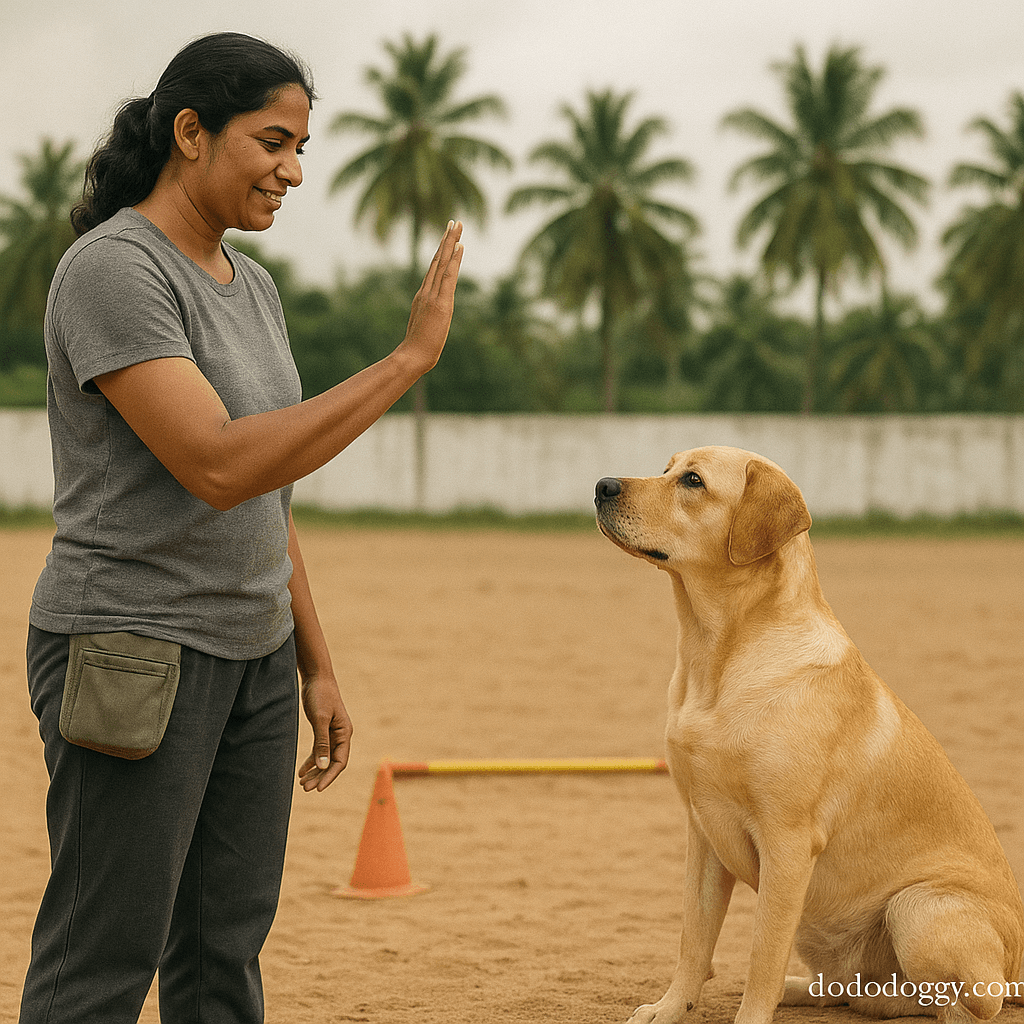
I'll walk through 'Come' in detail because it's the command with the steepest failure rate. Most people think they've trained it until their dog sees a cat and the recall vanishes completely. Here's the sequence that actually builds reliable recall.
Start in a closed room — bedroom or bathroom, somewhere with zero interesting distractions. Say the dog's name once, then 'Come' in a bright, happy tone. The moment they take even one step toward you, mark it with 'Yes!' and give a high-value treat. Not kibble. Something they'd cross a room for: small pieces of boiled chicken (₹150/kg at any local butcher, cut into pea-sized bits), or paneer cubes (₹80-120 per 100g, diced small).
Do this five or six times, then stop. Short sessions matter more than long ones — you want to end while the dog is still engaged and success rate is 100%. Next session, take two steps back before treating. Build distance over five to seven days.
Only move outdoors after indoor recall is reliable at 90%+ across three consecutive sessions. Outdoors, start in a quiet building compound at low-traffic hours, not the street. Walk the progression up: compound → quiet lane → park with low foot traffic. This phased approach is why properly trained dogs hit 75-85% recall success in genuinely distracting environments, according to positive reinforcement training research from the American Kennel Club.
Teaching 'Leave It': Your Best Defence Against Street Garbage
Every Indian city has street food waste, plastic, and the occasional dead thing on the footpath. 'Leave It' isn't optional.
Hold a treat in your closed fist. Let your dog sniff, paw, and lick at your fist. The moment they pause or pull back, say 'Yes!' and give a different treat from your other hand — never the one in your fist, or they learn that persistence gets rewarded. Repeat until they back away from the closed fist immediately. Then open your palm with a treat on it: cover it with your hand if they lunge. Progress to the treat on the floor with your foot hovering above. The final stage is a real-world object — a wrapper, a leaf — on the ground, with you holding the leash.
Bruno had this down in four days. Kuttie took twelve, because years of scavenging had made 'eat anything quickly' her survival instinct. Both got there. Allow for that variation in your expectations.
Positive Reinforcement vs Punishment: What the Evidence Shows
Punishment-based training — jerks on prong collars, yelling, alpha rolls — creates fear, not understanding. I know this not because I read it, but because I watched what happened to Bruno the first time someone on our apartment complex tried to 'correct' his jumping with a knee to the chest. He became nervous around unfamiliar men for four months.
Positive reinforcement methods produce 3-4x more reliable obedience than punishment-based approaches, according to peer-reviewed studies cited by WSAVA's behavior and wellness guidelines. In practice, this means: reward every correct behavior with something your specific dog values (most Indian dogs go crazy for chicken, paneer, or egg whites — not packaged liver treats). Mark the exact moment of correct behavior with a verbal 'Yes!' or a clicker click. Ignore incorrect behavior rather than punishing it.
Clicker training has gained strong adoption in Indian metros — trainers in Mumbai and Delhi report 65% faster acquisition of new commands compared to lure-only training, because the click marks the exact behavior that earned the reward. You can buy a basic clicker at any Heads Up For Tails or PetZone store for ₹100-300.
For more on understanding the behavioral signals that tell you training is working (or not), see our guide on dog body language for Indian dog owners.

Training in Indian Heat: The Summer Protocol
April through June in most Indian cities means 38-44°C afternoons. Dogs can develop heat exhaustion in under 20 minutes of outdoor activity during peak heat. Training doesn't stop, but the schedule does.
Warning
Heat protocol for April-June: Train outdoors ONLY before 8 AM or after 6:30 PM. Sessions max 10 minutes. Bring water and offer a break every 4-5 minutes. Watch for glazed eyes, excessive drooling, and stumbling — these mean end the session immediately. If temperatures exceed 40°C even at 7 AM (common in Rajasthan and UP), move fully indoors.
Indoor summer training isn't a compromise — it's an opportunity. The five commands above can all be taught and proofed indoors. Add trick training (spin, shake, play dead), impulse control drills (wait before meals, stay while I pretend to leave), and nose work games. Hide treats around the flat and let your dog search. Mental exercise in a 2 BHK can tire a Labrador more effectively than a 20-minute outdoor walk.
Treat quality matters more in heat because dogs' appetites drop. Switch to extra-small pieces — rice-grain sized — and use even higher-value rewards like tiny scraps of cooked meat. They'll still work for food, just not if the reward feels like it's not worth the effort of moving in 40°C heat.
Monsoon Training: Four Months Without Excuses
Mumbai, Chennai, and Kolkata dog owners know the monsoon problem. Outdoor training windows shrink to maybe 30 minutes a day if you're lucky. Many owners just... stop training. Then they're frustrated in October when all the progress from March has eroded.
Monsoon is actually the best time to solidify indoor obedience, because distractions are lower. Run commands in every room so your dog generalizes them — a dog that sits perfectly in the living room but ignores 'Sit' in the kitchen hasn't really learned the command. Work the hallway, the balcony (during breaks), the bathroom. Practice 'Stay' while you open and close the front door. Practice 'Leave It' near the dustbin.
If you have a terrace or covered car park area, use those for short outdoor sessions when rain permits. The unpredictability of monsoon weather also makes for good impulse control training — 'Wait' at the door when it's raining means your dog isn't dragging you into a downpour.
Diwali Desensitization: Start Six Weeks Early
Diwali is the hardest time of year for dogs in India. Some dogs pace and pant from October 20th to November 5th. Others bolt through open doors. A well-executed desensitization protocol genuinely helps — but only if you start six weeks out, not two days before.
The approach: search YouTube for 'Diwali firecracker sounds' or 'Diwali patakha noise' and play it at your phone's minimum volume during your dog's mealtime. Over two weeks, increase volume by two notches per session, always during a positive activity (feeding, play, or training). You're pairing the sound with something good. By Diwali, many dogs will be noticeably calmer, though not necessarily silent. Dogs with genuine sound phobia may need veterinary support — clomipramine and situational anti-anxiety medications are available from Indian vets, so speak to your vet if your dog's distress is severe.
On Diwali night itself, don't try to train. Close windows, play music or run a fan for white noise, give a food-stuffed rubber toy if your dog uses one, and just be present. The desensitization work is done weeks earlier — the night itself is containment and comfort. As Vetic's veterinary behavior team notes, dogs that have been through a structured desensitization protocol show measurably lower cortisol stress responses during festival fireworks.
Training Costs in India: What You'll Actually Pay
Cost varies enormously by city and trainer quality. Here's what current market rates look like across formats.
| Training Format | Typical Cost (INR) |
|---|---|
| DIY (treats, clicker, leash, collar) | ₹500 – ₹2,000 setup |
| Group classes (4-6 weeks) | ₹3,000 – ₹8,000 |
| Private trainer, basic obedience (6-8 weeks) | ₹9,000 – ₹15,000 |
| Advanced behavior correction programs | ₹15,000 – ₹25,000 |
| Home visit sessions (per session) | ₹1,500 – ₹3,000 |
| Superprof/online trainer marketplace rate | ~₹2,546/hr avg |
Metro pricing skews higher. Mumbai trainers from platforms like Snouters and Pawspace charge at the upper end of those ranges. Tier-2 cities — Lucknow, Jaipur, Coimbatore — typically run 30-40% cheaper for the same service quality. K9 School in Delhi offers structured 10-session obedience packages with experienced certified trainers.
The DIY option is genuinely viable for basic commands if you're consistent. The argument for professional help isn't convenience — it's efficiency. A good trainer spots the four things you're doing wrong in the first session and saves you three months of frustration. My recommendation: attempt DIY for the first four weeks with the protocol in this article. If you're not seeing steady progress, invest in even two or three private sessions for a diagnostic read on what's not working.
Choosing a trainer well is its own skill. For a full breakdown of what certifications to look for, red flags to avoid, and questions to ask before paying, see our guide on how to choose a dog trainer in India.
Training Indies and Rescue Dogs
If you've adopted an Indie from a shelter or taken in a community dog, you may be dealing with a dog that's never had commands, has fear responses from street life, or has trust deficits with strangers. None of that means they can't be trained. It means the foundation work is longer.
Indies are exceptionally sharp dogs. They've survived by reading human body language perfectly — which means they're faster to pick up on your cues than many imported breeds. Kuttie, the dog I mentioned earlier, learned 'Stay' in three days. She'd figured out that holding still meant chicken was coming, and once she understood the contract, she held that stay through everything.
The critical difference with rescue dogs and Indies is trust-building before training. Spend the first two weeks just existing alongside your dog without training demands. Let them explore, sniff, and settle. Once they're approaching you voluntarily and making eye contact, you've got enough trust to start command work. Rushing this phase produces dogs that comply out of anxiety, not understanding.
For the puppy angle — whether pedigree or Indie pup — our step-by-step puppy training guide for Indian homes covers the full 8-week foundation sequence.
Multi-Handler Households: The Joint Family Problem
This is a training issue almost no Western guide addresses: most urban Indian households are joint families or have multiple residents who all interact with the dog differently. Your mother uses 'Baitho,' your spouse uses 'Sit,' your kid uses 'Baiso,' and your grandfather uses a hand wave. The dog has no idea what any of you want.
Pick one word per command and use it consistently across all household members. Write it on a piece of paper and stick it to the fridge if you need to. 'Sit' is 'Sit' — not 'Sit down,' not 'Baitho,' not 'Hey stop.' Inconsistency doesn't just slow training down; it actively confuses dogs and can produce anxiety.
Also address the feeding consistency issue. If someone in the household gives table scraps or treats outside of training sessions, the dog's motivation for training treats drops. This is one of the main reasons professional trainers see slow progress in otherwise-committed families — one household member is inadvertently undermining the training framework.

Frequently Asked Questions
What is the best age to start obedience training for puppies in India?
How much does professional dog training cost in India?
Can Indian street dogs (Indies) learn obedience commands?
How do I train my dog during the Indian monsoon when outdoor sessions are limited?
Should I hire a professional trainer or train my dog myself?
How do I prepare my dog for Diwali fireworks?
What treats work best for dog training in India?
When to Call a Professional Immediately
Most obedience training is DIY-friendly. But there are situations where attempting to handle it yourself makes things worse.
Call a professional immediately if: your dog has bitten or attempted to bite (not mouthed — bitten), is showing fear aggression toward strangers or children, has resource guarding severe enough that approaching the food bowl causes growling or lunging, or has such severe separation anxiety that neighbors are complaining about noise and the dog is injuring itself.
These aren't training issues you refine. They're behavior problems that require assessment by someone who can read the dog in person. In India, look for trainers with certifications from K9 Companions India, DogGuru, or internationally recognized bodies like the International Association of Animal Behavior Consultants (IAABC). One-hour consultations typically cost ₹1,500-2,500. That hour often saves months of expensive trial and error.
For aggression specifically, see our full breakdown of dog aggression types, causes, and treatment approaches.