Dog Health in India: What Makes It Different
My Lab, Bruno, developed a tick fever in July 2022. We were in Pune, the monsoon was peak, and the vet told me he was seeing four such cases a day. The \u20b914,000 bill was painful. The lesson was more expensive: I had skipped his spot-on treatment the previous month because I thought one missed dose wouldn't matter.
India's disease environment for dogs is genuinely different from what you'd read on a US or UK pet site. Ticks are active year-round in most of the country, not just summer. Humidity in Mumbai and Chennai stays above 75% for six months, which means fungal skin conditions that barely exist in drier climates become a monthly battle here. Rabies is still endemic \u2014 that alone changes the vaccination calculus.
This guide pulls together the health information that actually matters in Indian conditions: climate-specific risks, real INR cost ranges from tier 1 and tier 2 cities, vaccination schedules that match what Indian vets recommend, and the emergency signs that need same-day attention. The dog dental health complete guide covers oral care in depth \u2014 this article focuses on the full-body picture.
Vaccination: The Foundation of Preventive Care
According to the WSAVA 2024 Vaccination Guidelines, core vaccines for dogs worldwide include protection against distemper, adenovirus, and parvovirus. In India, rabies is also considered core because the disease remains endemic and is 100% fatal once symptoms appear. Leptospirosis, which the WSAVA treats as a regional vaccine, should be considered core in India given how widely it spreads through monsoon floodwater.
Rabies vaccination is mandatory by law under the Animal Birth Control (ABC) Rules, 2001. Dogs without proof of rabies vaccination can be impounded, and owners face fines up to \u20b95,000. More to the point, a vaccinated dog that bites a person protects that person from a post-exposure vaccination ordeal and potential legal issues.
For full vaccination schedules including booster timing, the schedule varies slightly by vet and brand, but the core sequence for puppies runs from 6 weeks to 16 weeks with three DHPP doses, then annual boosters. See also the detailed vaccination booster guide for adult dog timing.
Vet Alert
Standard combination vaccines provide only 6-9 months of leptospirosis protection. If your dog walks in flooded streets or contacts strays during monsoon, schedule a booster in May before the June rains hit. Treatment of active leptospirosis runs \u20b915,000-50,000 and requires hospitalization.
| Age | Vaccine | Cost (INR) |
|---|---|---|
| 6-8 weeks | DHPP (first dose) | \u20b9800-1,500 |
| 10-12 weeks | DHPP (second dose) + Leptospirosis | \u20b91,000-1,800 |
| 14-16 weeks | DHPP (third dose) + Rabies | \u20b91,200-2,000 |
| Annual | DHPP + Rabies booster | \u20b91,500-2,500 |
| Optional annual | Kennel Cough, Canine Influenza | \u20b9600-1,200 each |
Parasite Control: Year-Round in India
Tick-borne diseases \u2014 Ehrlichiosis, Babesiosis, and tick fever caused by Anaplasma \u2014 are among the most common reasons Indian dogs are hospitalized. The monsoon from June to September sees peak tick activity, but I've seen my dogs pick up ticks in February in Bangalore. Year-round prevention isn't optional here.
For deworming, puppies from 6 weeks to 6 months need treatment every two weeks. Between 6 and 12 months, monthly. Adults need quarterly deworming at minimum \u2014 every three months. India's street dog population and warm, moist soil mean intestinal worm exposure is constant. A single deworming tablet like Petcare's Canex or Bayer's Drontal costs \u20b950-150, making this one of the cheapest health investments you'll make.
| Method | Duration | Monthly Cost (INR) |
|---|---|---|
| Spot-on (Fipronil) | 30 days | \u20b9300-600 |
| Oral tablet (Afoxolaner) | 30 days | \u20b9800-1,500 |
| Tick collar (Amitraz) | 3-8 months | \u20b9200-400 |
| Neem-based repellent | 7-14 days | \u20b9100-300 |
Money Saver
Combining an oral preventive with a spot-on gives near-complete tick protection during monsoon. Yes, it costs \u20b91,100-2,000/month for that period \u2014 but a single Babesiosis hospitalization runs \u20b98,000-25,000 and includes blood transfusions in severe cases.
Skin and Coat Health in Indian Climate
High humidity in coastal cities like Mumbai, Chennai, and Kochi creates the perfect environment for fungal infections. Ringworm, yeast dermatitis, and hot spots all spike during monsoon. My vet at DCC Animal Hospital in Pune sees three times more skin cases between June and September than any other period.
Mange \u2014 both sarcoptic and demodectic \u2014 is common, particularly in rescues and strays. Early treatment with medicated baths and oral ivermectin runs \u20b93,000-8,000. Left untreated, full-body mange treatment climbs to \u20b920,000 or more. Spot it early by watching for circular hair loss patches, intense itching, and red, crusty skin.
For grooming frequency and coat care by breed type, the dog coat care guide by breed type goes into detail. For bathing technique and tools suited to Indian conditions, see the dog grooming at home guide. The key points for skin health: dry thoroughly after every walk during monsoon, use antifungal shampoo fortnightly if your dog is prone to infections, and check paw pads and skin folds daily.
Dog skin diseases specific to India \u2014 including the full treatment cost breakdown \u2014 are covered in the dog skin diseases India guide.
| Coat Type | Bath Frequency | Example Breeds |
|---|---|---|
| Short, smooth | Monthly or as needed | Labrador, Beagle, Doberman |
| Medium, double coat | Every 6-8 weeks | German Shepherd, Golden Retriever |
| Long, silky | Every 3-4 weeks | Shih Tzu, Yorkshire Terrier |
| Curly, non-shedding | Every 4-6 weeks | Poodle, Bichon Frise |
Digestive Health and Common Gut Problems
Street food culture in India creates unique digestive risks. Dogs in Mumbai and Delhi regularly encounter dropped chaat, bones, and human food scraps on walks. Gastroenteritis from dietary indiscretion is one of the most common vet visits \u2014 a 12-24 hour fast followed by bland boiled chicken and rice usually resolves mild cases at home.
Parvovirus remains a genuine threat for unvaccinated puppies. The 50-70% survival rate with treatment reflects real outcomes from Indian veterinary hospitals \u2014 treatment requires hospitalization for IV fluids and supportive care at \u20b915,000-40,000. Vaccination at the standard schedule prevents it entirely. For dogs showing vomiting symptoms, the dog vomiting causes guide walks through when to wait and when to go immediately to the vet.
Maintaining gut health long-term means consistent feeding, clean water changed two to three times daily in summer, and probiotics during antibiotic courses or stressful periods. The dog gut health guide covers probiotic options and signs of chronic digestive issues. For ongoing diarrhea, the dog diarrhea treatment guide gives home care protocols and vet visit triggers.
Warning
Never feed dogs onions, garlic, grapes, raisins, chocolate, xylitol, or spicy food. These cause organ damage and can be fatal. The foods never to feed your dog guide has the complete list with toxicity levels.
Eye and Ear Care
India's dusty air \u2014 especially in Delhi and Rajasthan during summer \u2014 puts dogs at higher risk of conjunctivitis and corneal ulcers. Brachycephalic breeds like Pugs and Shih Tzus have prominent eyes that are particularly prone to injury and dryness. Daily cleaning with saline solution or veterinary eye wipes (\u20b9150-300/pack) removes dust and prevents tear stain buildup. For detailed guidance on conditions affecting eyes, the dog eye health guide covers diagnosis and treatment.
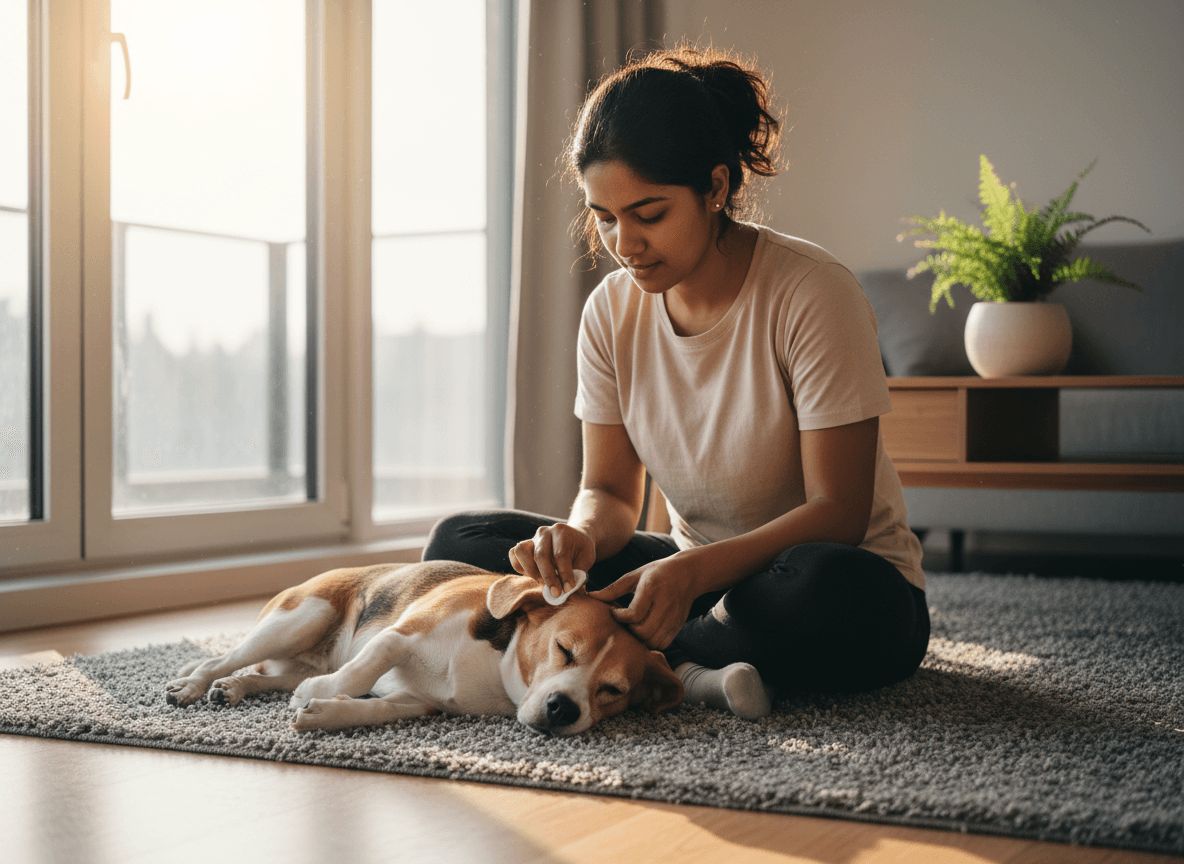
Ear infections peak during monsoon when humidity exceeds 80%. Floppy-eared breeds \u2014 Cocker Spaniels, Beagles, Labradors \u2014 are most susceptible. Weekly ear cleaning with veterinary ear cleaner (\u20b9200-400/bottle) during dry months, and twice-weekly during monsoon, prevents most infections. The dog ear infections India guide covers treatment, costs, and the difference between yeast and bacterial infections.
Nutrition Basics for Indian Dogs
Indian dogs in hot, humid climates need slightly higher protein (25-30%) and moderate fat (12-18%) to support immune function. According to CarryMyPet's 2025 dog ownership cost breakdown, premium commercial kibble runs \u20b93,500-8,000/month for a medium-sized dog \u2014 brands like Royal Canin, Farmina, and Drools are widely available and meet AAFCO standards.
Homemade diets work well when formulated properly: roughly 40% protein (chicken, eggs, fish), 30% carbohydrates (rice, sweet potato), 30% vegetables (pumpkin, carrots, green beans) plus calcium and vitamin supplements. The comparison between these approaches is explored in the homemade vs commercial dog food guide. For commercial food comparison specifically \u2014 wet food vs dry food for dogs breaks down cost and nutrition differences.
Food allergies are more common than many owners realize. Chronic itching, ear infections, and loose stools can all trace back to a food ingredient. See the dog food allergies guide if your dog shows these recurring signs.
Seasonal Health: Monsoon (June-September)
June through September is the highest-risk period for Indian dogs. Humidity climbs above 85% in Mumbai, Chennai, and Kolkata. Stagnant water collects everywhere, and tick and mosquito populations explode. My vet in Pune told me she sees three to four times more skin, ear, and tick fever cases during these months.
Leptospirosis risk spikes sharply in monsoon. The bacteria live in rat urine and spread through contaminated puddles and floodwater. Carry small dogs through waterlogged streets rather than letting them walk through. Signs of infection \u2014 sudden fever, vomiting, jaundice, muscle pain \u2014 appear 5-14 days after exposure. Treatment costs \u20b915,000-50,000.
The monsoon health issues guide for dogs covers the full seasonal checklist. Short version: wash and dry paws after every walk, clean ears twice weekly, use antifungal shampoo fortnightly, wash bedding weekly, and keep your dog's leptospirosis booster current.
Seasonal Health: Summer (March-June)
North India in May regularly hits 45\u00b0C. Rajasthan, UP, Bihar, and parts of MP see temperatures where pavement reaches 65\u00b0C at midday \u2014 hot enough to cause third-degree burns on paw pads in 60 seconds. The rule: if you can't hold your palm on the pavement for five seconds, don't walk your dog on it. Walk before 7 AM and after 7 PM only.
Heat stroke is a medical emergency. Excessive panting, drooling, bright red gums, vomiting, and collapse are the warning signs. Cool your dog immediately with wet towels, offer small amounts of water, and drive to the nearest vet. Do not use ice \u2014 it causes blood vessel constriction and slows cooling. The heat stroke in dogs guide has the full emergency cooling protocol.
Safety First
Never leave your dog in a parked car in Indian summer. Interior temperatures reach 60\u00b0C within 10 minutes. This is the leading cause of preventable dog deaths in India's summer months.
Senior Dog Care (7+ Years)
Large breeds are considered senior at 7-8 years; small breeds at 10-11 years. Senior dogs need bi-annual vet visits instead of annual. A full senior screening panel \u2014 Complete Blood Count, Chemistry Panel, Urinalysis, Thyroid Panel, and chest X-ray \u2014 runs \u20b95,000-12,000 and can catch kidney disease, diabetes, or tumors while they're still treatable.
Arthritis is common in senior Indian dogs, particularly larger breeds and overweight dogs. Joint supplements containing glucosamine and chondroitin (\u20b9800-2,000/month) and prescription anti-inflammatories (\u20b9500-1,500/month) make a real difference in comfort. Orthopedic memory foam beds (\u20b92,000-8,000) and ramps for furniture access reduce joint strain daily. For the full care picture, see the senior dog care tips guide and the senior dog care guide for India.
Emergency Signs That Need Immediate Vet Attention
Some symptoms need same-day care, not a wait-and-see approach. Difficulty breathing, collapse, seizures, a distended abdomen with unproductive retching (possible bloat/GDV), bleeding that won't stop, suspected poisoning, and inability to urinate all fall in this category. The pet first aid emergency guide gives step-by-step triage protocols.
For poisoning specifically \u2014 common Indian home toxins include rat poison (bromadiolone), pesticides, xylitol in sugar-free products, certain houseplants, and sometimes holi colors \u2014 see the dog poisoning prevention guide for the full list. Night emergency surcharges run 50-100% above daytime rates in most Indian cities. Save your nearest 24-hour emergency clinic's number now, before you need it.
| Emergency | Key Signs | Typical Cost (INR) |
|---|---|---|
| Heat stroke | Excessive panting, red gums, collapse | \u20b95,000-25,000 |
| Bloat (GDV) | Distended abdomen, unproductive retching | \u20b940,000-1,00,000 |
| Poisoning | Vomiting, seizures, tremors, collapse | \u20b98,000-50,000 |
| Parvovirus | Bloody diarrhea, vomiting, lethargy in pups | \u20b915,000-40,000 |
| Severe bleeding | Uncontrolled bleeding from wound | \u20b95,000-30,000 |
Veterinary Costs in India: What to Budget
Vet consultation fees in India range from \u20b9300-500 at local clinics to \u20b91,500-2,500 at specialty hospitals in Mumbai, Delhi, and Bangalore. According to CarryMyPet's 2025 pet ownership cost guide, metro city vaccination and vet visit costs run 10-30% higher than smaller towns. A detailed breakdown of every common procedure is in the vet costs India 2026 price guide.
| Service | Tier 1 Cities (\u20b9) | Tier 2/3 Cities (\u20b9) |
|---|---|---|
| Annual health checkup | 1,500-3,500 | 800-2,000 |
| Vaccinations (DHPP + Rabies) | 1,500-2,500 | 800-1,500 |
| Deworming (4 doses/year) | 200-600 | 150-400 |
| Flea/tick prevention (monthly) | 7,200-14,400 | 4,800-9,600 |
| Premium kibble (monthly) | 42,000-72,000 | 30,000-60,000 |
Pet insurance is worth calculating for your specific dog's risk profile. Bajaj Allianz, New India Assurance, and Care Pet Insurance offer annual premiums from \u20b94,000-12,000 for \u20b91-3 lakh coverage. The pet insurance guide for India explains what's covered and what isn't \u2014 most plans exclude pre-existing conditions and hereditary diseases. The what pet insurance covers guide gives a plain-language breakdown of typical policy inclusions.
Building a Dog Health Emergency Kit
A basic first aid kit costs \u20b92,000-5,000 and handles minor injuries, allergic reactions, and stabilization before reaching the vet. Keep it in a waterproof container with clear labels.
- Wound care: sterile gauze, medical tape, antiseptic solution (chlorhexidine), antibiotic ointment (\u20b9150-400)
- Tools: digital thermometer (normal dog temp 38-39.2\u00b0C), tweezers for tick removal, nail clippers
- Information: vet contact numbers, nearest 24-hour emergency clinic address, dog's vaccination certificates and medical records
- Comfort: muzzle, e-collar, clean towels, blanket
- Medications: any prescribed ongoing medications, antihistamine (dosage confirmed with vet)
Building Healthy Habits: Your Monthly Checklist
Prevention is consistently cheaper than treatment in Indian conditions. The dogs I've seen live the longest aren't owned by people with the most money \u2014 they're owned by people who stay consistent with the basics: monthly parasite prevention, quarterly deworming, annual vaccinations, twice-yearly vet checkups for adults (bi-annually for seniors), and daily observation.
- Monthly: Apply flea/tick prevention, check weight, note any skin or coat changes
- Quarterly: Deworm, check teeth for tartar buildup, trim nails
- Annually: DHPP + Rabies boosters, full health checkup, fecal test for parasites
- Bi-annually (seniors 7+): Full blood panel, urinalysis, thyroid test, chest X-ray
You'll find good options like Dr. Palampalle's Pet Care Clinic in Pratikhsha Nagar, Sion East, Sion — rated 5.0/5. Check our pet stores in Mumbai directory for more choices near you.
You'll find good options like Harish pathak pet shop in pune in Durvankur Colony, Indrayani Nagar, Shivtirth Nagar, Thergaon — rated 4.8/5. Check our pet stores in Pune directory for more choices near you.
Set aside \u20b92,000-5,000/month in a dedicated pet health fund. Emergency surgeries \u2014 foreign body removal, bloat, ACL repair \u2014 run \u20b925,000-1,50,000. Having that buffer means your dog gets care immediately rather than after a financial scramble.